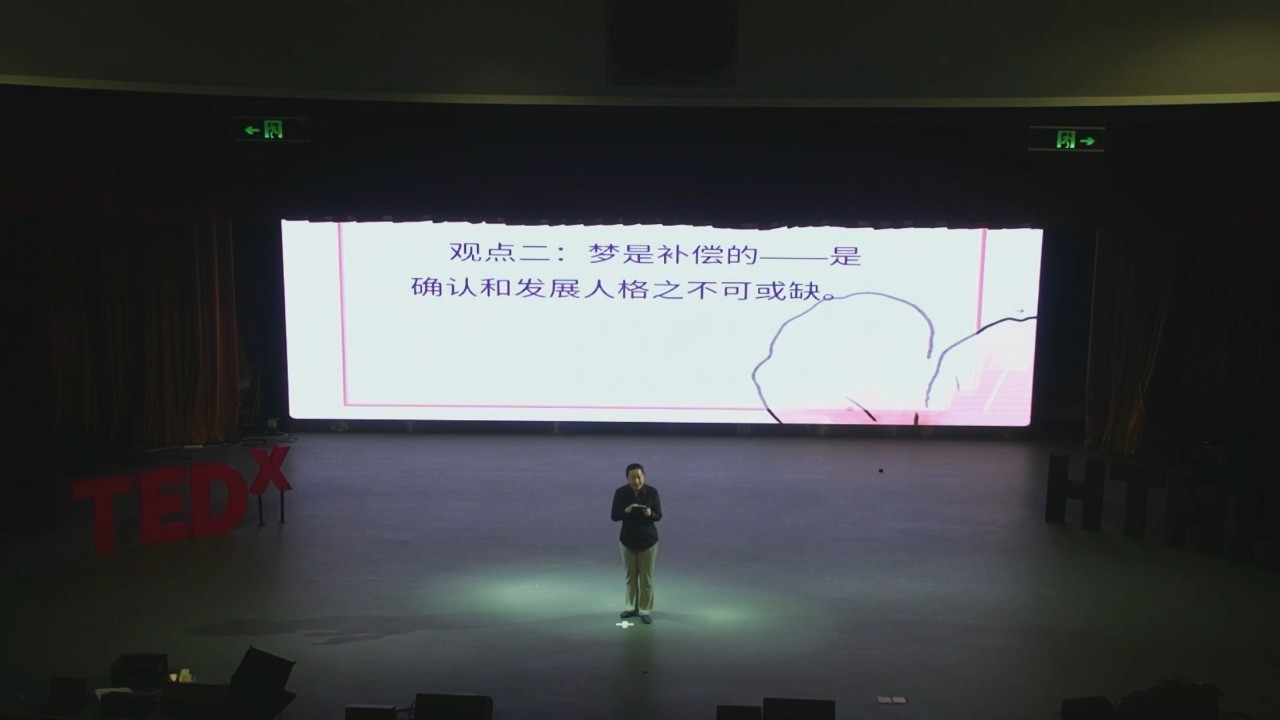
关于梦我想说 | 浚 许 | TEDxHTNIA Youth
What I Want to Say About Dreams | Jun Xu | TEDxHTNIA Youth
Title history
- 关于梦我想说 | 浚 许 | TEDxHTNIA Youth — observed on 20261026-1337 UTC (YouTube)
Keywords
Summary
158 words
Critical Evaluation
Value of the Information & Strength of the Argument
The talk offers a clear introduction to Jungian dream theory and practical methods for dream interpretation. The argumentation is consistent with psychodynamic principles, emphasizing the role of the unconscious and compensation. The speaker uses relatable examples and a structured approach, but the evidence is primarily anecdotal, drawn from clinical experience rather than systematic research. The value lies in its accessible explanation of complex psychological concepts and actionable advice for self-reflection.
Scientific Rigor, Source Quality, Title Accuracy
The talk references Carl Jung and mentions concepts like ’lucid’ and ‘compensation’, but no specific sources are cited beyond the speaker’s professional expertise. The TEDx description provides only the generic TEDx link. The title accurately represents the content, which is a personal and professional perspective on dreams. The presentation is coherent and well-organized, though the scientific basis relies on established Jungian theory without empirical validation. The lack of external references limits its rigor, but the content is internally consistent and grounded in a recognized psychological framework.
171 words
Title / Content Match
The title accurately reflects the talk's content about dreams from a psychoanalytic perspective.
Quality & Reliability
6/10
The talk presents Jungian analytical psychology concepts (unconscious, compensation, dream interpretation) but relies heavily on anecdotal evidence and personal clinical experience. It does not provide empirical data or citations to peer-reviewed studies. The information is coherent with established psychodynamic theory but lacks scientific rigor as presented.
Key Moments
Markers derived by PSI from the transcript: the creator did not define chapters.
- Introduction and definition of dream work
- First idea: dreams transmit the soul's authentic information
- Jung quote about outward/inward looking
- Example of dream about cat to illustrate emotional neglect
- Second idea: dreams have a compensatory function
- Practical guide 1: free association method with three questions
- Example of math teacher dream and its interpretation
- Practical guide 2: nightmares as psychological defense training
- Conclusion: keep a dream journal and invite dreams
- Closing remarks and gratitude
Cited Sources
- TEDx Official Page — The description links to the general TEDx page, indicating the talk was independently organized under TEDx guidelines.
Contribution & Novelties
The talk provides a digestible summary of Jungian dream interpretation and offers practical self-help techniques for high school students and general audiences. It contributes to public dissemination of psychoanalytic concepts, though it does not introduce novel scientific findings.
Pour aller plus loin :
- Analytical Psychology — Overview of Jung’s theoretical framework, foundational to the talk’s concepts.
- Dream interpretation — Historical and cultural perspectives on dream meaning, relevant to the methods discussed.
- Compensation (psychology) — Concept referenced by Jung, explaining the balancing function of dreams.
- Free association — Technique used in psychoanalysis, central to the speaker’s practical guide.
97 words
Radar Profile
The radar profile shows moderate scores across all dimensions, indicating a balanced but not exceptional presentation. The talk is informative and concrete but lacks deep technical depth and rigorous sourcing, reflecting its general-audience orientation.