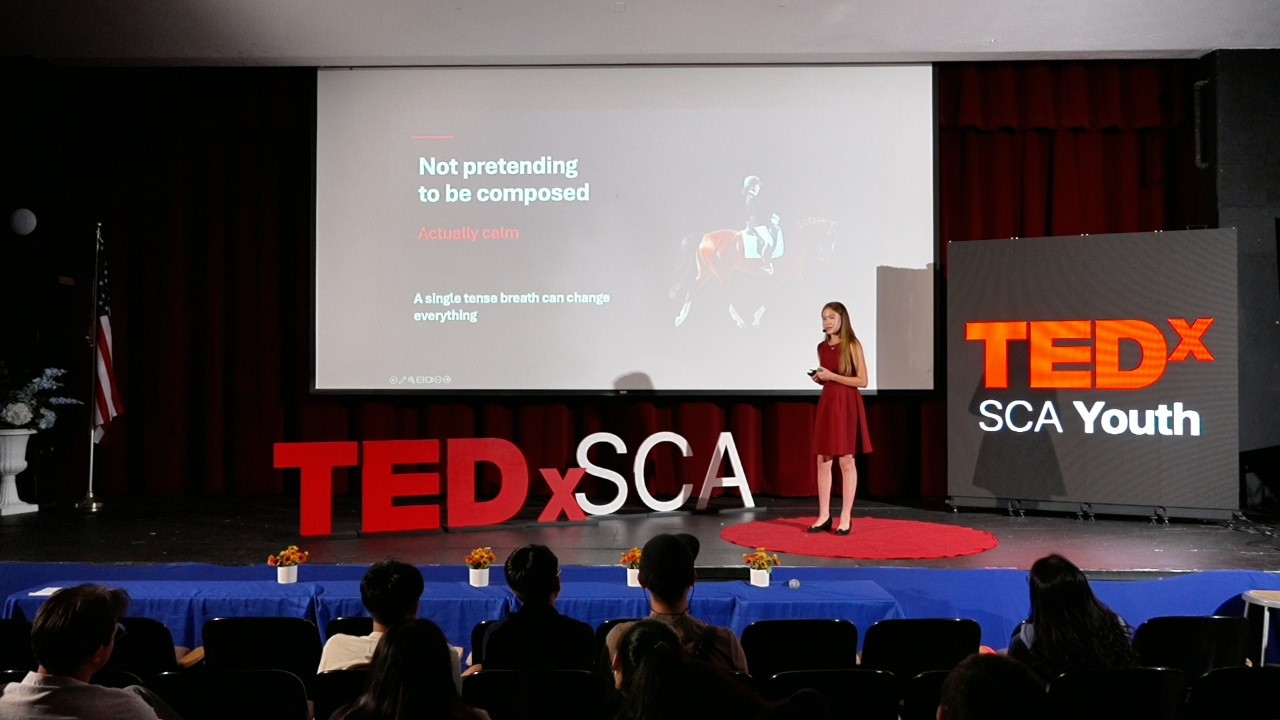
The 1200-Pound Teacher | Anna Banas-Chen | TEDxSCA Youth
Keywords
Summary
218 words
Critical Evaluation
Value of the Information & Strength of the Argument
The talk offers valuable insights into the importance of non-verbal communication and authenticity, drawing parallels between equine behavior and human interactions. The speaker’s personal experience in riding, research, and advocacy lends credibility, and she effectively uses concrete examples and scientific references to support her arguments. The argumentation is coherent and persuasive, moving from specific observations about horses to broader applications for human relationships. The introduction of neuroception and heart rate variability adds scientific depth, while the anecdote about her horse Devon provides an emotional anchor. However, the talk would benefit from explicit citations and more rigorous discussion of the research, as some claims are presented without detailed evidence. Nevertheless, the core message—that biological honesty builds trust—is compelling and well-argued.
Scientific Rigor, Source Quality, Title Accuracy
The scientific rigor is moderate: the speaker references general concepts like neuroception and heart rate variability but does not specify studies or provide detailed source materials. The talk relies on her own research and personal observations, which are plausible but not exhaustive. The title is highly appropriate, as the ‘1200-pound teacher’ is the horse, and the talk consistently elaborates on what humans can learn from equine behavior. The content aligns well with the title, and the speaker’s storytelling effectively reinforces the central metaphor. The only external source provided is the general TEDx link, limiting the ability to verify specific claims. Overall, the talk is scientifically sound in its simplifications, but for a rigorous audience, more citations would be beneficial.
253 words
Title / Content Match
The title effectively captures the central metaphor of the horse as a teacher, and the talk consistently develops this idea.
Quality & Reliability
7/10
The talk presents scientific concepts accurately but relies on anecdotal evidence and lacks formal citations. The speaker, a young equestrian with research experience, supports her claims with plausible scientific references, yet the content is accessible and simplified for a general audience.
Key Moments
Markers derived by PSI from the transcript: the creator did not define chapters.
- Demonstration of a subtle body shift and its effect on a horse
- Explanation of horse sensory abilities and touch receptors
- Introduction of neuroception and heart rate variability synchronization
- Personal story about preparing for dressage competition with her horse Devon
- Application to human relationships and the impact of AI on communication
- Challenge to be genuine and align words with body language
- Closing reflection on her '1200-pound teacher'
Cited Sources
- TEDx Talks — Official TEDx page providing context for the talk and its format.
Contribution & Novelties
The talk’s original contribution lies in drawing a compelling analogy between equine trust and human authenticity, emphasizing that small physiological signals can determine the quality of relationships. It integrates concepts from neurobiology and psychology with practical advice for communication, particularly relevant in an era of AI-generated text. The speaker’s personal research and advocacy add a unique perspective, showing that young people can contribute to scientific discourse.
Pour aller plus loin :
- Polyvagal Theory — Provides a framework for understanding how the nervous system influences social engagement and safety, directly relevant to the concept of neuroception.
- Heart Rate Variability — Explains the physiological basis of stress and synchronization, relating to the talk’s mention of heart rate synchronization between horse and rider.
- Equine-assisted therapy — Discusses therapeutic applications of horse interactions, which connect to the talk’s emphasis on non-verbal trust building.
139 words
Radar Profile
The radar profile shows balanced scores across information quantity, quality, technical level, and reliability, with a slight emphasis on quality and technical depth. The talk provides a moderate amount of information that is well-structured and accessible, while maintaining scientific rigor without being overly technical. This suggests a well-rounded presentation suitable for a general audience.