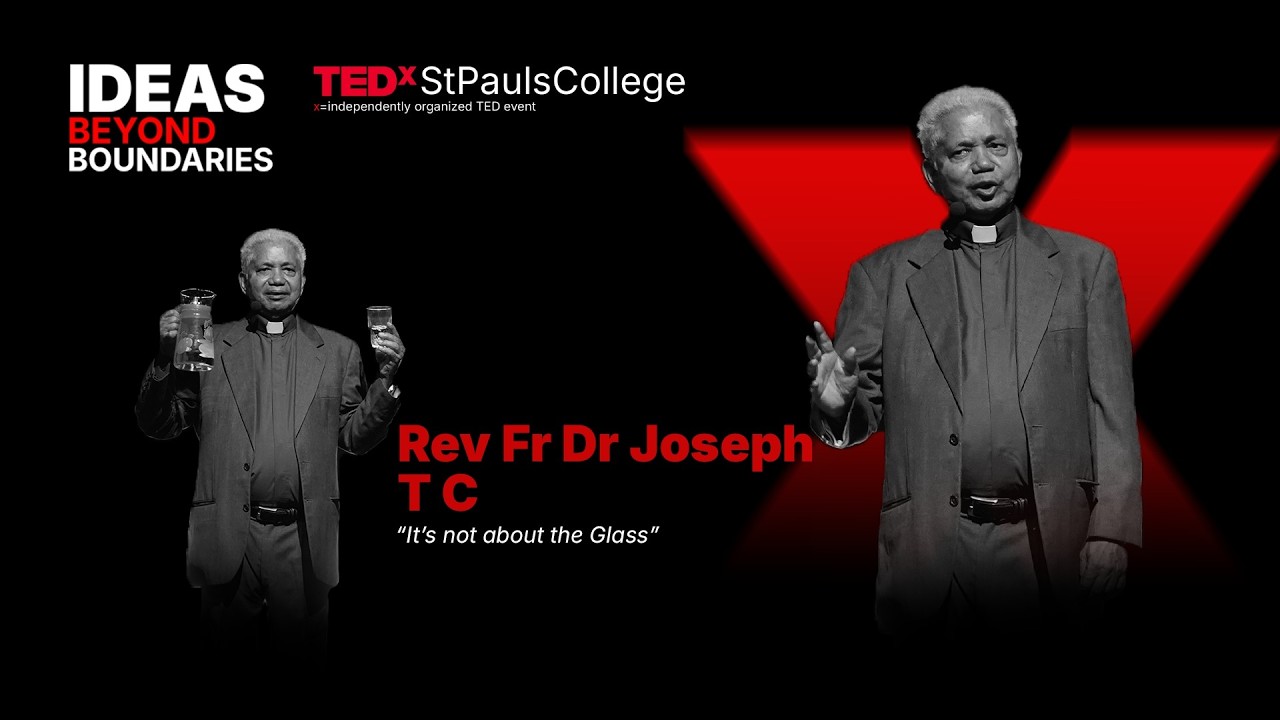
It’s Not About the Glass | Rev Fr Dr Joseph T C | TEDxSt Pauls College
Title history
- It’s Not About the Glass | Rev Fr Dr Joseph T C | TEDxSt Pauls College — observed on 20261029-1652 UTC (YouTube)
Keywords
Summary
168 words
Critical Evaluation
Value of the Information & Strength of the Argument
The talk offers a fresh, memorable reframing of a familiar metaphor. Its value lies in shifting focus from static interpretation to dynamic action, which can inspire practical change in outlook. The argumentation is logical and accessible, using everyday examples (waiter, architect) and historical patterns (scientists, inventors) to illustrate that attention follows purpose. The speaker avoids oversimplification by distinguishing genuine pessimism from constructive dissatisfaction, and by affirming gratitude while cautioning against complacency. The reasoning is coherent, though it relies on anecdote rather than empirical evidence; this is typical for motivational talks and does not undermine its persuasive power.
Scientific Rigor, Source Quality, Title Accuracy
The talk is primarily a personal reflection with no explicit external sources cited. The only source provided in the description is the TEDx program link, which serves as a general reference for the event format. While the content aligns with established psychological concepts (e.g., cognitive reframing, growth mindset), the speaker does not reference specific studies or authors. This limits the rigor from an academic standpoint, but the talk is not intended as a scientific discourse. The title is perfectly adequate—it highlights the central theme without being misleading, and the content fully matches the implied scope.
207 words
Title / Content Match
The title accurately captures the central metaphor while hinting that the focus is on perspective and action rather than the glass itself. It is concise and enticing, setting expectation for a reflective talk.
Quality & Reliability
6/10
The talk is well-structured and coherent, drawing on common observations and philosophical reasoning rather than empirical evidence. It presents a clear, practical message but lacks rigorous sources or data. The speaker's authority comes from leadership and life experience, not from formal research.
Key Moments
Markers derived by PSI from the transcript: the creator did not define chapters.
- Introduction of the glass metaphor and questioning its traditional interpretation.
- Examples of waiter and architect showing that attention follows purpose.
- Distinction between gratitude and complacency; civilizations move forward because grateful people also dream.
- Reframing the question: 'What are you going to do with the other half?' as more revealing.
- Personal reflection on invisible glasses and the need to balance appreciation and aspiration.
- Final image: holding gratitude and possibility, reaching for the pitcher.
Cited Sources
- TEDx Program — The talk was delivered at a TEDx event; this link provides information about the TEDx format and independently organized events.
Contribution & Novelties
The talk’s original contribution is the shift from interpreting the glass as a static object to asking about action—‘What will you do with the other half?’ It integrates gratitude and ambition into a unified framework, avoiding the false choice between being content and being driven. This provides a practical mental model for personal growth.
Pour aller plus loin :
- Cognitive reframing — Highly relevant; the talk essentially proposes a reframe of a common perception.
- Gratitude — The role of gratitude in well-being is well documented; the talk aligns with this research.
- Growth mindset — Carol Dweck’s concept of growth mindset resonates with the idea of seeing possibility in empty spaces.
110 words
Radar Profile
The profile shows a talk that is low on technical detail and information density but high on clarity and emotional resonance. The significant gap between technique and reliability indicates a non-empirical, inspirational message, while the moderate quality score reflects its well-structured argumentation and practical value.