"Jean-Charles de Borda, un científico excepcional y discreto", conferencia en la Fundación Orotava
"Jean-Charles de Borda, an exceptional and discreet scientist," lecture at the Orotava Foundation
Title history
- "Jean-Charles de Borda, un científico excepcional y discreto", conferencia en la Fundación Orotava — observed on 20261030-1307 UTC (YouTube)
Keywords
Summary
164 words
Critical Evaluation
Value of the Information & Strength of the Argument
The value of this presentation lies in its detailed and well-researched narrative, drawing on primary sources from the Borda Museum and historical documents. The speaker effectively argues that Borda, although largely forgotten today, was a key figure in multiple scientific and technological advances during the Enlightenment. The argumentation is coherent and progresses logically from Borda’s early life to his later achievements, emphasizing his methodical approach and innovative instruments. Specific examples, such as the reflecting circle and the standardization of warships, are supported with concrete anecdotes and references. The speaker’s expertise as a curator adds credibility, and the inclusion of rare maps and instruments enhances the informative value. However, the talk is one-sided, offering few critical perspectives on Borda’s limitations or controversies, and the technical explanations are sometimes simplified for a general audience.
Scientific Rigor, Source Quality, Title Accuracy
The scientific rigor is generally high, as the speaker relies on archival materials, museum collections, and published works, including Borda’s own publications such as ‘Description et usage du cercle à réflexion’ and the report of his voyages. The presentation respects historical accuracy, though some claims are based on local tradition (e.g., Borda’s Freemasonry) without strong evidence. The quality of sources is good, but the talk relies heavily on the speaker’s personal expertise and the museum’s holdings, with no external scholarly citations provided. The title is appropriate and matches the content, as it captures Borda’s exceptional yet low-profile character. The video lacks a critical evaluation of the sources, but the overall rigor is acceptable for a lecture aimed at a general audience.
268 words
Title / Content Match
The title accurately reflects the content, as the talk presents Borda as an exceptional yet discreet scientist, detailing his key contributions and personal characteristics.
Quality & Reliability
7/10
The talk is given by the curator of the Borda Museum, presenting detailed historical facts from archival sources. The content is specific and well-structured, but as a single lecture, it lacks critical cross-examination. Some technical explanations are simplified for a general audience.
Key Moments
Markers derived by PSI from the transcript: the creator did not define chapters.
- Introduction: Why Borda is present on the Eiffel Tower and in other commemorations.
- Borda's birth, family background, and early education at the Jesuit college of La Flèche.
- Naval career and initial scientific work on fluid resistance and ship construction.
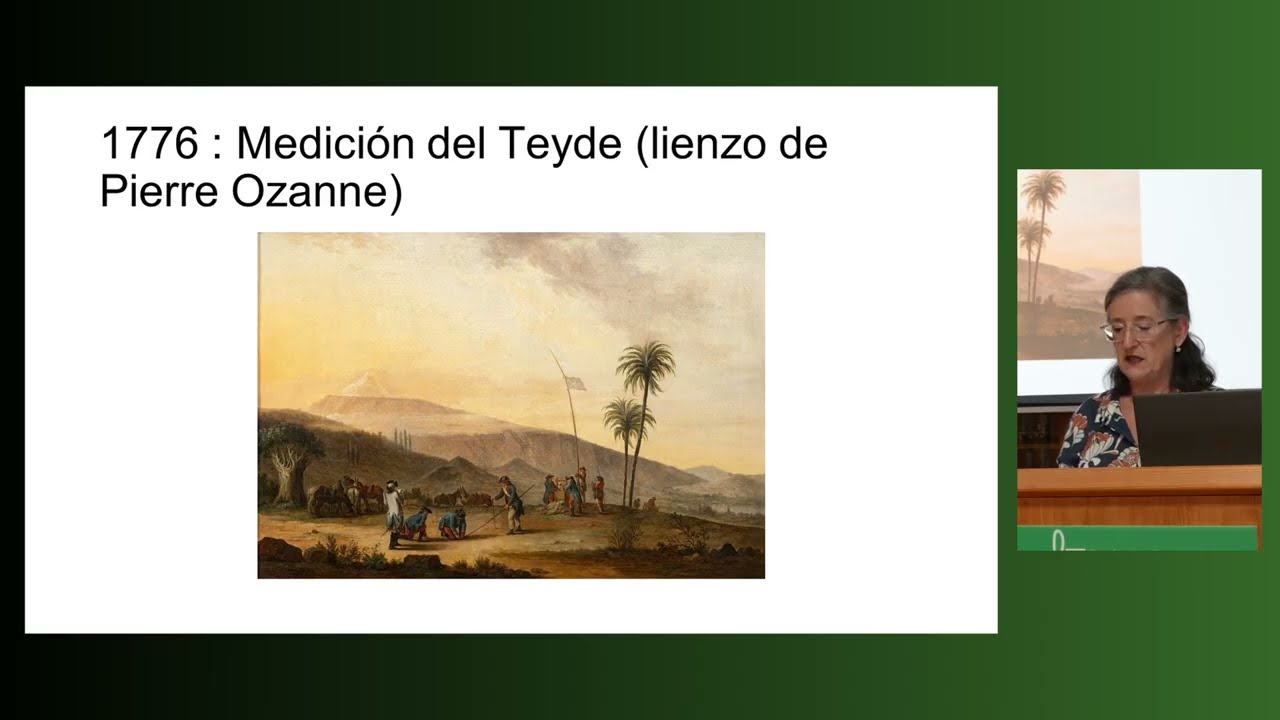
- Invention of the reflecting circle and its use in the measurement of Mount Teide.
- Standardization of French warships: reducing the fleet to three classes and collaboration with Sané.
- Involvement in the metric system: the commission and the measurement of the meridian arc.
Cited Sources
- Description et usage du cercle à réflexion — Borda's publication explaining the reflecting circle and its use in navigation.
- Voyage fait par ordre du roi en 1771 et 1772 — Account of the expedition aboard La Flora, including charts and observations of the Canary Islands.
- Carte des îles Canaries et d'une partie de la côte occidentale d'Afrique — Map produced by Borda after his expeditions, held in the Borda Museum.
Contribution & Novelties
This video provides a unique, museum-based perspective on Jean-Charles de Borda, highlighting his often-overlooked contributions to navigation, geodesy, and naval engineering. It brings to light the reflecting circle, an instrument that predates the sextant in many applications, and details Borda’s role in the standardization of French warships and the metric system. The talk also shares valuable primary documents from the Borda Museum, including maps and instruments, offering a tangible connection to historical science.
Pour aller plus loin :
- Jean-Charles de Borda - Wikipedia — Reliable overview of Borda’s life and scientific works.
- Reflecting circle - Wikipedia — Explanation of the instrument invented by Borda for angular measurement.
- Meridian arc - Wikipedia — Background on the measurement of the Earth’s meridian, a key element of the metric system’s definition.
128 words
Radar Profile
The radar profile shows a high quantity of information (8/10) and moderate quality (7/10), with a technical level of 6/10 making it accessible yet detailed. Overall reliability is rated 7/10, reflecting the expert source but limited independent verification.