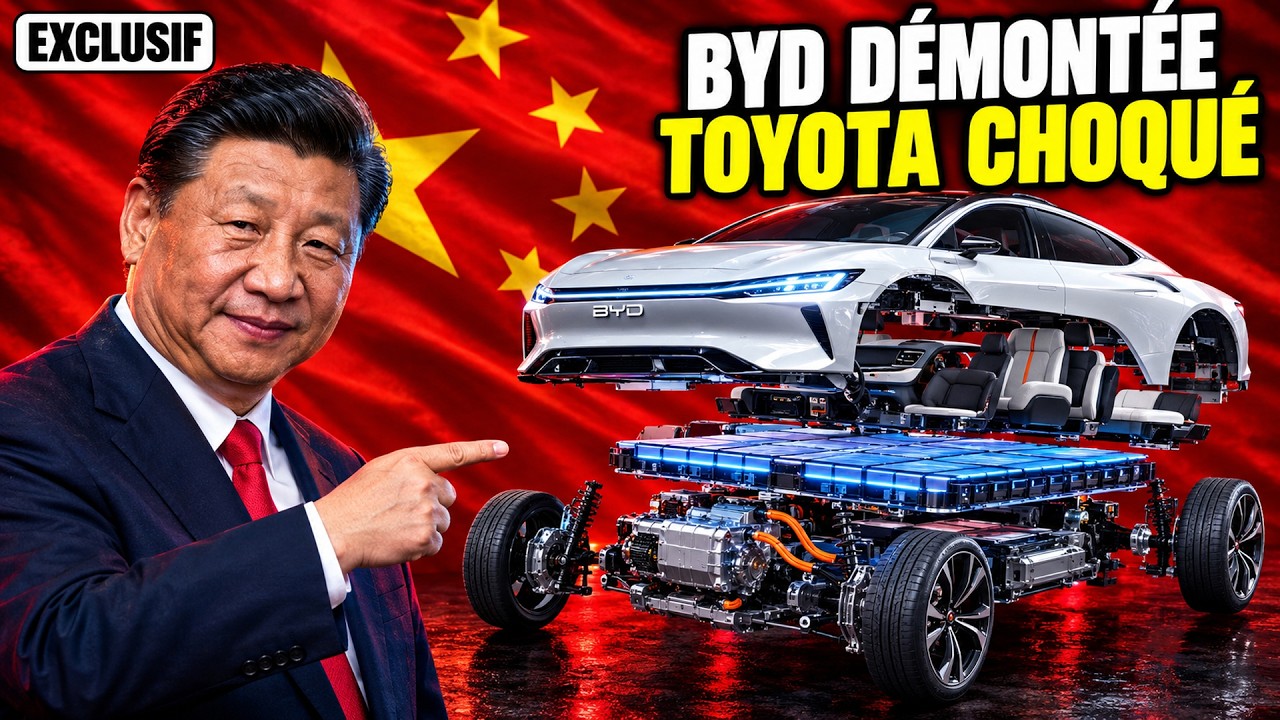
Le Japon A Démonté Une BYD. Toyota A Un Problème.
Japan Disassembled a BYD. Toyota Has a Problem.
Keywords
Summary
154 words
Critical Evaluation
Value of the Information & Strength of the Argument
The video provides substantial value by synthesizing multiple independent teardown analyses—Japanese, Swiss, and American—into a coherent narrative about the global EV industry. It effectively argues that BYD’s success is not based on cheap labor or subsidies but on radical vertical integration and simplified design. The argumentation is solid: each claim is supported by specific figures (e.g., 75% in-house components, 35% cost advantage) and attributed to concrete reports. The twist—that Toyota itself relies on BYD’s technology—is backed by model-specific sales data and component sourcing details. The reasoning is logical, and the video acknowledges limitations (e.g., BYD’s profit margins, Japan market challenges), offering a balanced view.
Scientific Rigor, Source Quality, Title Accuracy
Rigorously researched, the video cites a wide range of reputable sources: Collision Repair Magazine, Nikkei BP, Notebook Check, 36kr, UBS via Yikai Global, Associated Press, Car News China, Electrive, CN Post, and Transport Topics. Each source is mentioned in context, and the video explicitly states its methodology: cross-referencing manual details with UBS teardown data and financial reports. The title is directly aligned with the content, focusing on the teardown and its implications for Toyota. The video also notes the historical inversion—BYD learned from Toyota—which strengthens its interpretive depth. Though the creator did not purchase the Nikkei BP manual, they transparently explain their reliance on secondary reporting, which is a minor limitation. Overall, the sourcing is exemplary for a YouTube production.
239 words
Title / Content Match
The title accurately reflects the content: it focuses on Japan's teardown of a BYD and suggests a strategic problem for Toyota. The video thoroughly covers both aspects, including the minicar launch and Toyota's dependence on BYD components.
Quality & Reliability
8/10
The video relies on multiple credible sources (Nikkei BP, UBS, Associated Press, Collision Repair Magazine) and provides specific numbers, dates, and cross-references. It demonstrates a systematic approach to analyzing teardowns and financial data, with balanced consideration of both BYD and Toyota strengths.
Chapters
Cited Sources
- Nikkei BP teardown manual of BYD Seal — Mentioned as a 350-page book published in June 2023, sold to industrialists at ~$6,340, analyzing the BYD Seal.
- UBS teardown analysis — Reported by Yikai Global; UBS dismantled the Seal and estimated 75% in-house content and 35% cost advantage over European EVs.
- Caresoft Global teardown of BYD Seagull — Led by former GM chief engineer Terry Woychowski, detailed by Associated Press; highlighted single wiper blade and overall design efficiency.
- Collision Repair Magazine article on Nagoya event — Reported the October 2024 teardown of an Atto 3 attended by ~70 suppliers and the permanent display center.
- Transport Topics article on Toyota sales — Cited for Toyota being world's largest automaker for 6th year in 2025 with 11.3 million vehicles sold.
- Car News China reports on BYD finances and RACO launch — Provided data on BYD's revenue decline, domestic sales slump, and details on the RACO kei car orders.
- Electrive article on BYD RACO — Specified RACO pricing, battery options, and that it is exclusively for the Japanese market.
- CN Post article on RACO orders — Reported 1,002 orders two weeks after launch and target of 10,000 by end of 2026.
- Notebook Check — Mentioned as source for details on the Nikkei BP manual and historical comparison.
- 36kr — Japanese tech portal cited for participation of four major automakers in manual analysis and for Caresoft insights.
Concurring Sources
- UBS teardown cost analysis — Supports video's claim of 35% cost advantage for BYD.
- Associated Press coverage of Caresoft — Confirms BYD Seagull's build quality and low cost, aligning with video's assessment.
- Collision Repair Magazine — Corroborates the Nagoya teardown event and permanent display center.
Contribution & Novelties
The video’s original contribution lies in weaving together multiple teardown studies to expose an underreported industrial inversion: Japan dissects a Chinese car while Japanese automakers simultaneously integrate Chinese components. It provides fresh context by connecting BYD’s historical learning from Toyota to its current dominance in vertical integration, supported by up-to-date financial figures and the 2026 RACO launch. The piece also nuances the narrative by highlighting Toyota’s hybrid-driven profits and BYD’s domestic struggles, offering a balanced outlook.
Pour aller plus loin :
- Lithium iron phosphate battery — Core chemistry of BYD’s Blade Battery, central to cost reductions.
- Vertical integration — Key strategy for BYD’s cost control and in-house component production.
- Kei car — Japanese vehicle class targeted by BYD RACO, crucial to understanding market entry.
- Cell-to-Body technology — Architecture that integrates battery cells into the car body, a differentiator for BYD (note: Wikipedia page may not exist, alternative: structural battery ).
150 words
Radar Profile
The radar profile shows high scores in quantity and reliability, reflecting the video's dense data and strong sourcing. Technical level is slightly lower, as the content focuses more on industrial strategy than engineering deep-dive, but remains accessible. Overall, a well-rounded analysis.