EMBL Keynote Lecture - Synthetic Biology Foundations and Health Related Applications, Ron Weiss
Title history
- EMBL Keynote Lecture - Synthetic Biology Foundations and Health Related Applications, Ron Weiss — observed on 20261026-0212 UTC (YouTube)
Keywords
Summary
161 words
Critical Evaluation
Value of the Information & Strength of the Argument
The talk provides substantial value by showcasing concrete experimental results and new technologies, particularly the PERSIST platform and polytransfection method, which address critical limitations in mammalian synthetic biology such as copy number heterogeneity and epigenetic silencing. The argumentation is solid, backed by quantitative data on repression/activation folds, long-term stability experiments, and comparisons to standard systems like Tet-On/Off. Weiss also thoughtfully discusses design principles and the trade-off between biological realism and engineering convenience, offering a nuanced perspective on the field’s philosophy. The presentation is technically dense, but the speaker effectively communicates complex concepts with clear analogies and visual aids (though not shown in transcript). The inclusion of ongoing experiments and honest discussions of challenges strengthens the credibility of the claims.
Scientific Rigor, Source Quality, Title Accuracy
The scientific rigor is high: Weiss references specific studies, his own published work, and ongoing collaborations. He mentions the 222-page synthetic biology roadmap and names systems like the Tet-Off system and CRISPR. However, no direct URL citations are provided in the description, so external sources are not explicitly listed. The title is perfectly aligned with the content, accurately reflecting the lecture’s scope. The talk is well-structured, moving from foundational concepts to advanced applications. No contradictions or unsupported claims were identified; the presentation is consistent with established knowledge in synthetic biology. The audience feedback (not provided) would likely be positive given the technical depth and clarity.
239 words
Title / Content Match
The title accurately reflects the content: a keynote lecture on synthetic biology foundations with explicit focus on health-related applications.
Quality & Reliability
9/10
Presentation by a leading synthetic biology researcher from MIT at a reputable institution (EMBL). The talk includes experimental data, published methodologies, and references to ongoing research.
Key Moments
Markers derived by PSI from the transcript: the creator did not define chapters.
- Introduction and three phases of synthetic biology: from foundational circuits to complex systems and applications.
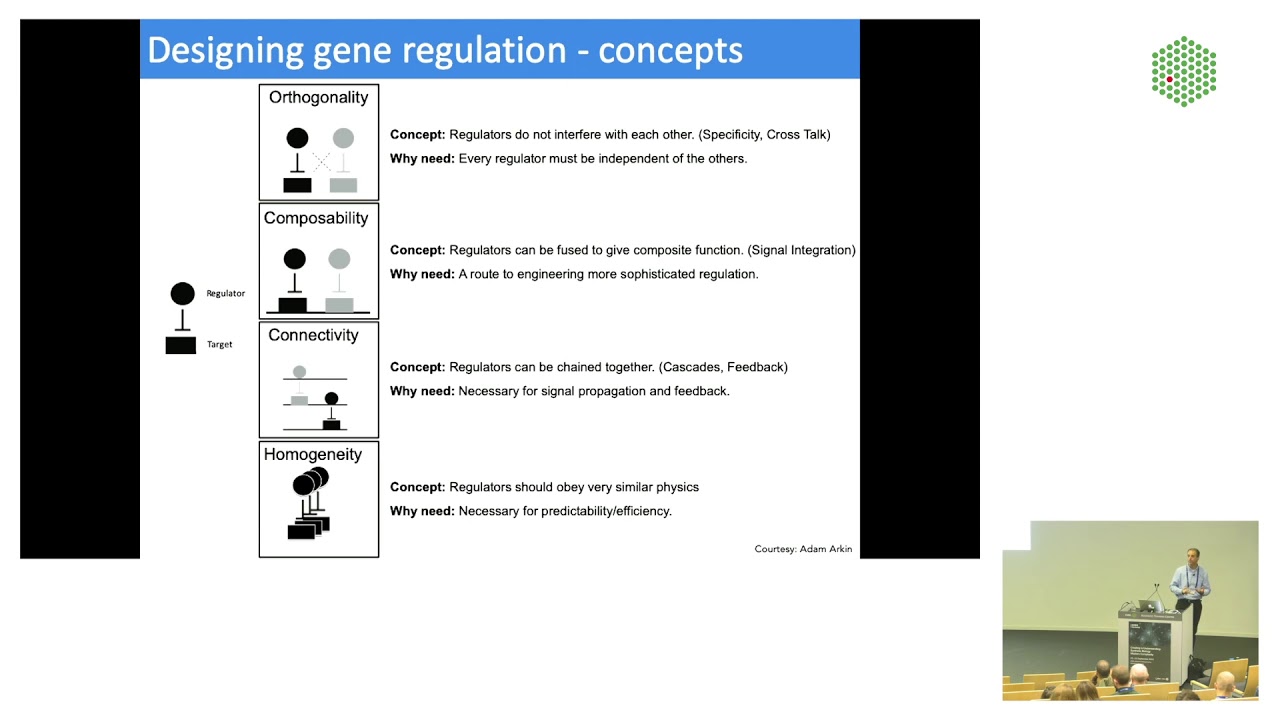
- Discussion of design principles including abstraction, modularity, composability, and the importance of delivery methods.
- Introduction to translational control using endoribonucleases, motivation for overcoming epigenetic silencing.
- PERSIST platform: RNA-based ON/OFF switches with up to 200-fold activation, and polytransfection method for characterization.
- Description of phosphorylation-based circuits for rapid response and their potential in applications.
- Cancer immunotherapy applications: multi-input genetic circuits for detecting and destroying specific cancer cells.
- Programmable organoids: co-differentiation of hiPSC-derived progenitors with GATA6 pulse to create liver bud-like tissues.
Contribution & Novelties
The lecture presents a distinct contribution by introducing the PERSIST platform for programmable endonucleolytic RNA-scission-induced stabilization tuning, which offers a new approach to synthetic biology switches that resist epigenetic silencing. Additionally, the polytransfection method accelerates characterization of genetic circuits in mammalian cells. These innovations provide practical tools for biomanufacturing and cell-based therapies.
Pour aller plus loin :
- Synthetic Biology on Wikipedia — Overview of the field and its principles.
- CRISPR gene editing — Background on the CRISPR system used for endoribonuclease derivation.
- Genetic toggle switch — Context on foundational synthetic circuits like toggle switches and oscillators.
- Organoid research — Background on organoid development and applications, relevant to the programmable organoids section.
111 words
Radar Profile
The radar profile is consistently high across all dimensions, reflecting a technically deep and information-rich presentation. The high level of technical content and reliable sourcing indicates a specialized audience, with moderate to high novelty in the presented methodologies.