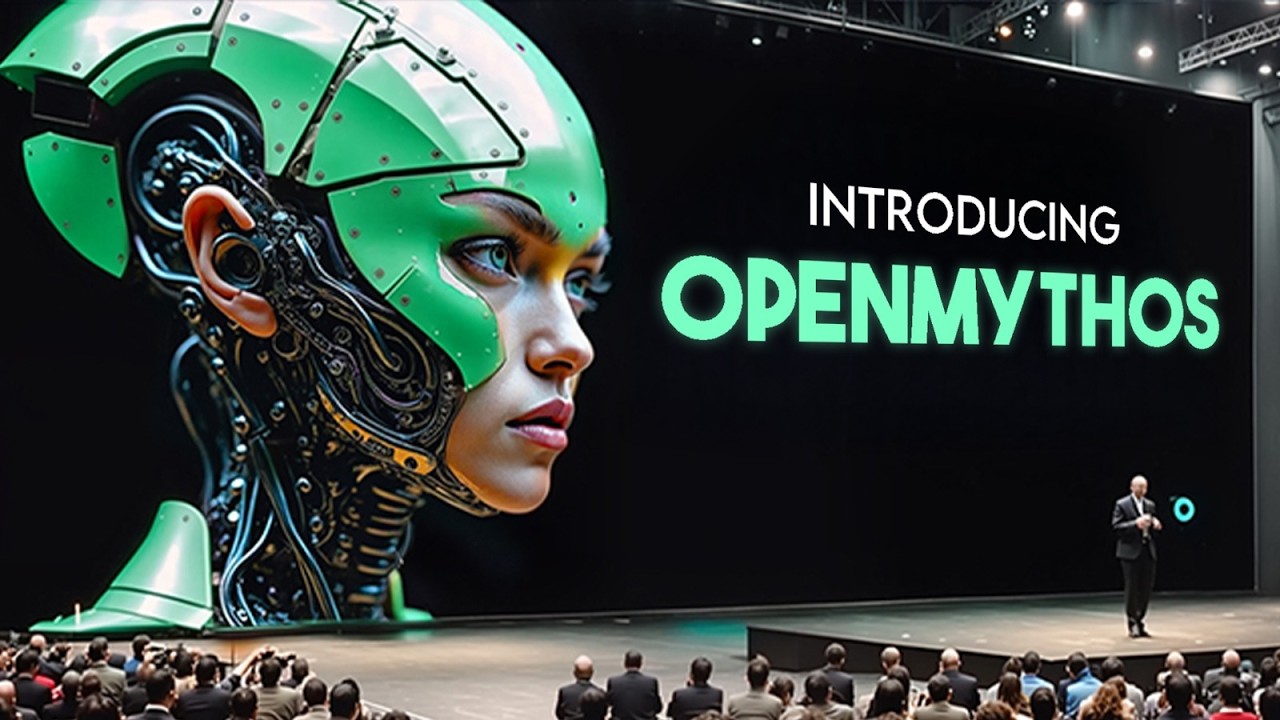
Claude Mythos Clone Shocks Anthropic and OpenAI
Keywords
Summary
110 words
Critical Evaluation
Value of the Information & Strength of the Argument
The video provides a clear and accessible explanation of the Recurrent-Depth Transformer concept, highlighting its potential advantages in efficiency and reasoning. The argumentation is structured, moving from the technical details of OpenMythos to broader industry trends. However, the claims are largely based on the developer’s own reports and the video’s sources, which are not independently verified. The presentation is persuasive but may overstate the significance of these developments without sufficient critical analysis.
Scientific Rigor, Source Quality, Title Accuracy
The video cites several sources in the description, including articles from MarkTechPost, DataConomy, and SCMP, which lend some credibility. However, the video itself does not critically evaluate these sources, and the tone is promotional. The title is somewhat sensationalist but aligns with the content’s focus on OpenMythos. The comments show a mix of enthusiasm and skepticism, with some viewers questioning the feasibility and others praising the efficiency approach.
155 words
Title / Content Match
The title is somewhat sensationalist but accurately reflects the video's focus on the OpenMythos project and its potential impact.
Quality & Reliability
6/10
The video presents a mix of reported facts and speculative analysis, with sources provided for major claims but lacking independent verification. The tone is enthusiastic and sometimes hyperbolic, and the technical explanations are simplified for a general audience.
Key Moments
Markers derived by PSI from the transcript: the creator did not define chapters.
- Introduction to OpenMythos and the 22-year-old developer
- Breakdown of the Recurrent-Depth Transformer design
- Explanation of the Prelude, Loop, Coda architecture
- Mixture of 384 Experts and how it works
- 770M parameters matching 1.3B performance
- Reasoning in latent space and its advantages
- Depth extrapolation test results
- Stability, overthinking, and latent attention
- Scaling shifts to inference
- Moonshot AI Kimi K2.6 model and agent swarm system
Cited Sources
- Meet OpenMythos: An Open-Source PyTorch Reconstruction of Claude Mythos — Source for the OpenMythos project details and performance claims.
- OpenMythos Project Attempts to Reconstruct Claude Mythos Design — Source for the architectural breakdown of OpenMythos.
- Moonshot AI Releases Flagship Model as Open Source Push Continues — Source for Kimi K2.6 release and benchmark claims.
- xAI Launches Standalone Grok Speech-to-Text and Text-to-Speech APIs — Source for Grok API details and pricing.
Concurring Sources
- OpenMythos Project Attempts to Reconstruct Claude Mythos Design — Provides similar architectural details as the video.
Dissenting Sources
- Comment: 'Nobody is able to clone because it’s not published publicly.' — A commenter disputes the claim that OpenMythos is a true clone, noting it is not publicly available in full capacity.
External References
Contribution & Novelties
The video’s main contribution is to popularize the concept of Recurrent-Depth Transformers and the OpenMythos project, which challenges the conventional scaling paradigm. It synthesizes information from multiple sources to present a coherent narrative about the shift towards efficiency and inference-time compute. The video also highlights the broader trend of modularity and parallelism in AI models.
Pour aller plus loin :
- Recurrent neural network — Foundational concept for recurrent architectures.
- Mixture of experts — Key technique used in OpenMythos and Kimi K2.6.
- Latent space — Concept central to the ‘reasoning in latent space’ discussion.
- DeepSeek — Company known for multi-latent attention, referenced in the video.
104 words
Radar Profile
The radar profile shows a balanced but moderate performance across all dimensions, with slightly higher scores in information quantity and technical level. This suggests the video provides a decent overview but lacks depth and critical rigor.
💬 Positif. Sur les 30 commentaires analysés, la majorité exprime un intérêt et un enthousiasme pour l'architecture récurrente et l'efficacité, avec quelques réserves sur la faisabilité et la disponibilité publique.