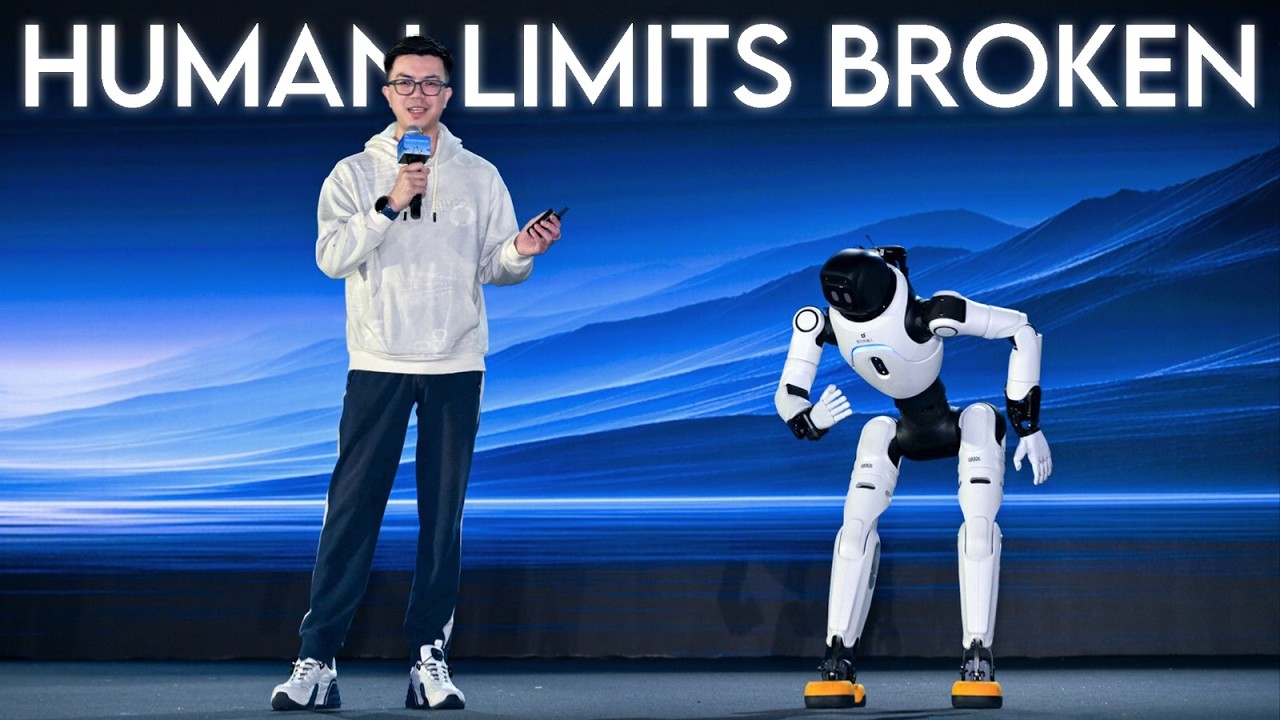
New AI Robot From China Breaks Human Limits
Keywords
Summary
142 words
Critical Evaluation
Value of the Information & Strength of the Argument
The video provides a valuable overview of recent robotics developments, synthesizing information from multiple sources into a coherent narrative. It highlights key technical specifications and innovations, such as Agibot’s multi-robot coordination and the self-healing actuator, which are significant for the field. The argumentation is structured around the idea that these advancements collectively push robotics toward real-world deployment. However, the presentation is promotional, with a clear bias toward showcasing progress rather than critically examining limitations. The video lacks independent analysis and relies heavily on company announcements and press releases, which may overstate readiness. The discussion of π0.7’s capabilities is intriguing but acknowledges the lack of standardized benchmarking, indicating the need for caution.
Scientific Rigor, Source Quality, Title Accuracy
The video cites several credible sources, including Agibot’s official announcements, a Science Advances paper, EurekAlert, AP News, and Physical Intelligence’s blog. These sources are reputable and directly relevant to the claims made. However, the video does not provide critical evaluation of these sources, and some claims, such as the exact race times, are presented without cross-verification. The title accurately reflects the content, focusing on Chinese robots breaking human limits, which is a central theme. The video’s rigor is moderate: it presents information from reliable sources but lacks independent verification and critical analysis. The inclusion of a sponsored segment (Outskill) is clearly marked and does not detract from the scientific content.
236 words
Title / Content Match
The title accurately reflects the content, which focuses on Chinese humanoid robots and AI models pushing performance boundaries.
Quality & Reliability
7/10
The video aggregates recent robotics developments from multiple credible sources (Agibot, Science Advances, AP News, Physical Intelligence), but the presentation is promotional and lacks critical depth. Claims are mostly consistent with cited sources, though some details (e.g., exact race times) are presented without independent verification.
Key Moments
Markers derived by PSI from the transcript: the creator did not define chapters.
- Introduction to the video's topics: Agibot's new robots, self-healing muscle, Beijing half-marathon, and π0.7.
- Agibot's 2026 partner conference: 'one robotic body, three intelligences' architecture.
- Details on the A3 humanoid: height, weight, power-to-weight ratio, battery swap, and multi-robot coordination.
- G2 Air mobile manipulator for human-robot collaboration.
- OmniHand 3 UltraT dexterous hand with 22+ degrees of freedom and tactile sensing.
- D2 Max quadruped and Migo data collection platform.
- Eight foundational AI models for locomotion, manipulation, and interaction.
- Seoul National University's self-healing artificial muscle using phase-transitional ferrofluid.
- Beijing half-marathon: humanoid robots beat human world-record pace.
- Physical Intelligence's π0.7 model with compositional generalization.
Cited Sources
- AGIBOT's 2026 embodied AI rollout — Source for Agibot's new robots and AI models.
- AGIBOT Partner Conference 2026 overview — Overview of Agibot's partner conference.
- Seoul National University researchers unveil a reconfigurable self-healing artificial muscle — Press release about the self-healing muscle.
- Science Advances paper on the new actuator system — Peer-reviewed paper on the actuator.
- Coverage of Beijing’s humanoid robot half-marathon — AP News article on the half-marathon.
- Physical Intelligence introduces π0.7 — Blog post about π0.7 model.
Concurring Sources
- AGIBOT's 2026 embodied AI rollout — Consistent with the video's claims about Agibot's new robots.
- Science Advances paper — Supports the self-healing muscle claims.
- AP News article — Corroborates the half-marathon results.
Dissenting Sources
- No discordant sources found — The video's claims are consistent with the cited sources, though independent verification is lacking.
External References
Contribution & Novelties
The video synthesizes recent robotics developments, highlighting Agibot’s full-stack deployment ecosystem, the self-healing actuator, and π0.7’s compositional generalization. It provides a useful overview for those following the field, but does not offer original analysis. The ‘one robotic body, three intelligences’ architecture and the Migo data collection platform are notable innovations.
Pour aller plus loin :
- Humanoid robot — Background on humanoid robots.
- Dielectric elastomer actuator — Relevant to the self-healing muscle.
- Compositional generalization — Concept behind π0.7’s capabilities.
- Physical Intelligence — Company behind π0.7.
84 words
Radar Profile
The radar profile shows high scores in quantity of information and technical level, indicating a content-rich video with detailed specifications. Quality and reliability are moderate, reflecting the promotional tone and lack of critical analysis. Overall, the video is informative but should be complemented with primary sources for a balanced view.