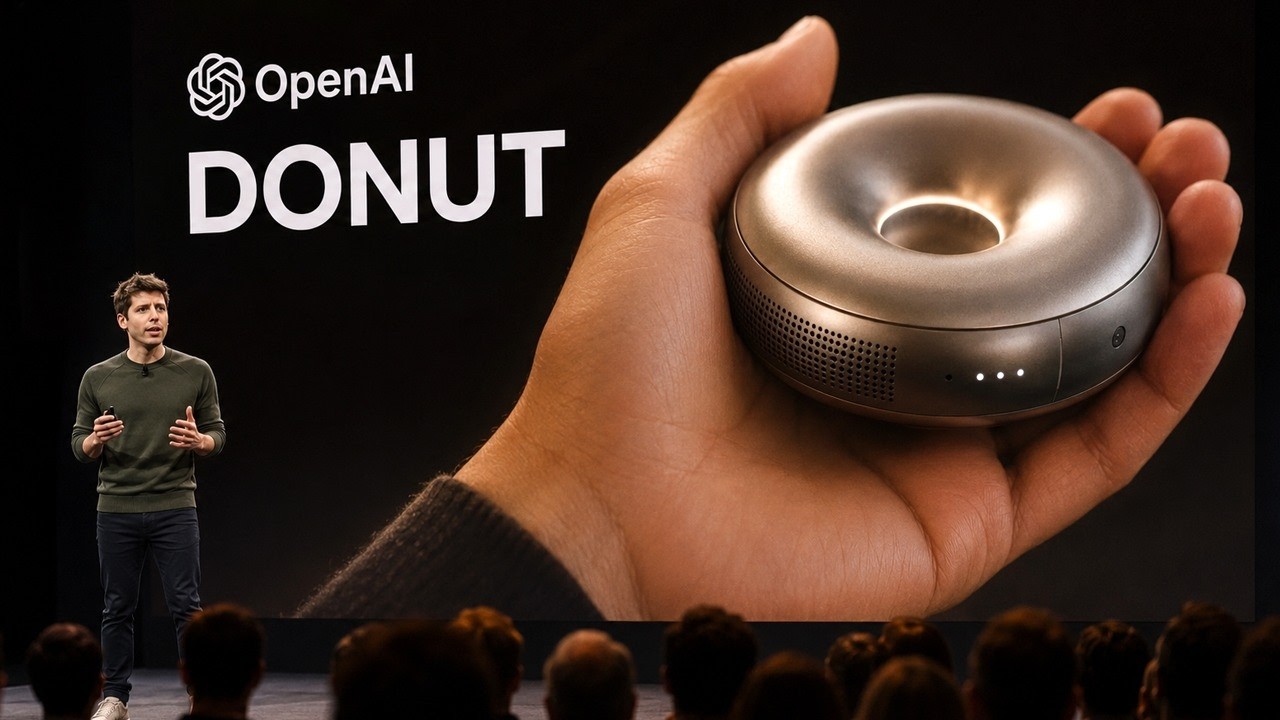
OpenAI’s Controversial AI Device Just Leaked… And It’s Literally a Donut
Keywords
Summary
131 words
Critical Evaluation
Value of the Information & Strength of the Argument
The video provides a clear and structured overview of the leaked information, synthesizing details from a Bloomberg report and contextualizing them with the Apple lawsuit. The author’s argumentation is coherent, presenting the device as a strategic move towards an ‘AI-native’ computing model. He effectively contrasts this with the ‘AI-plus’ approach of existing smart speakers. The inclusion of the lawsuit adds depth, showing the competitive tensions. However, the argumentation relies heavily on speculation and interpretation, with limited concrete evidence. The video’s value lies in its synthesis and analysis, but it does not provide original reporting or verification.
Scientific Rigor, Source Quality, Title Accuracy
The video cites its sources (Bloomberg via The Verge, Reuters) and clearly distinguishes between reported facts and speculation. The title is accurate and not misleading. The video’s scientific rigor is moderate: it presents a balanced view, acknowledging the uncertainty of the leak and the speculative nature of some claims. The sources are reputable, but the reliance on a single primary report limits the depth of verification. The video does not critically evaluate the sources’ reliability beyond noting Mark Gurman’s track record.
192 words
Title / Content Match
The title accurately reflects the content: the video discusses the leaked OpenAI device, its donut shape, and the controversy with Apple.
Quality & Reliability
7/10
The video is based on a single Bloomberg report (via Mark Gurman) and two secondary sources (The Verge, Reuters). It clearly distinguishes between the leaked information and the author's interpretation. However, the lack of primary sources and the speculative nature of some claims (e.g., the photo of Joe Gebbia) reduce the overall reliability.
Key Moments
Markers derived by PSI from the transcript: the creator did not define chapters.
- Introduction: The leak of OpenAI's first hardware device, a donut-shaped smart speaker.
- Details of the device: ring-shaped, battery-powered, split design with charging base, no display, speakers, microphones, camera, sensors.
- Price and launch window: $300-$400, expected 2027 launch.
- The movable mechanical structure and its purpose: to give the device 'presence' and indicate its state.
- The Apple lawsuit: trade secret accusations, OpenAI's motion to dismiss, and the comparison of product roadmaps.
- The thesis: AI-native computing vs. AI-plus, and the shift from screens to intent-based interaction.
- Comparison with Humane's AI Pin and the social acceptability of always-on cameras.
- Conclusion: The potential impact of the device and the author's final thoughts.
Cited Sources
- OpenAI’s first device is reportedly a screenless, donut-shaped AI speaker — Primary source for the device leak details.
- Apple accuses OpenAI of stealing hardware trade secrets for its AI devices — Source for the Apple lawsuit details.
- OpenAI asks a judge to dismiss Apple’s trade-secret lawsuit — Source for OpenAI's motion to dismiss.
Concurring Sources
- OpenAI’s first device is reportedly a screenless, donut-shaped AI speaker — The Verge's report aligns with the video's description of the device.
Dissenting Sources
- Apple accuses OpenAI of stealing hardware trade secrets for its AI devices — The lawsuit presents a conflicting narrative, accusing OpenAI of using Apple's trade secrets, which the video discusses but does not endorse.
External References
Contribution & Novelties
The video’s main contribution is its synthesis of the leaked information and its analysis of the strategic implications for OpenAI and the AI hardware market. It connects the device to the broader concept of ‘AI-native’ computing, contrasting it with the ‘AI-plus’ approach. The video also highlights the significance of the Apple lawsuit in the context of the device’s development.
Pour aller plus loin :
- AI-native (concept) — The concept of ‘AI-native’ is discussed in the video; this link provides a related, though not identical, definition of ’native’ in software.
- Jony Ive — Background on the designer behind the device.
- Humane AI Pin — A previous attempt at a screenless AI device, mentioned in the video as a cautionary tale.
119 words
Radar Profile
The radar profile shows a balanced video with moderate scores across all dimensions. The quantity and quality of information are decent, but the technical depth is limited, and the reliability is moderate due to reliance on a single leak. This suggests a well-produced news summary rather than an in-depth technical analysis.
💬 Negative. Sur les 30 commentaires analysés, la majorité exprime du scepticisme ou des critiques, notamment sur la vie privée, l'utilité et le design, avec quelques commentaires humoristiques.