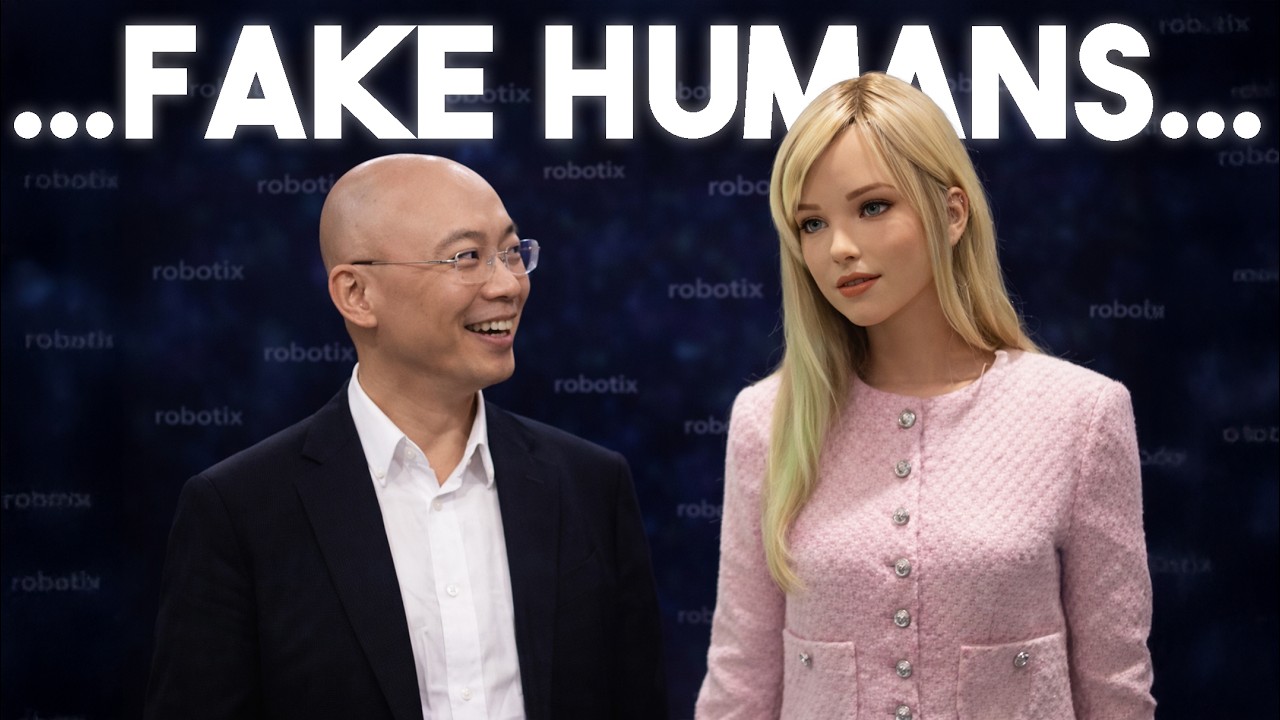
New AI Robot Is Starting to Feel Human (Artificial Humans Are Here)
Keywords
Summary
153 words
Critical Evaluation
Value of the Information & Strength of the Argument
The video provides a valuable overview of recent robotics news, with each segment offering specific technical details and context. The argumentation is generally solid, presenting each development with its claimed capabilities and potential applications. However, the presentation is largely uncritical, often adopting press-release language without independent verification or discussion of limitations. The inclusion of a sponsored segment on AI video generation is clearly separated but still interrupts the flow. Overall, the information is useful for staying updated, but the lack of critical perspective reduces its scientific value.
Scientific Rigor, Source Quality, Title Accuracy
The video cites multiple sources in the description, including press releases from BusinessWire, PR Newswire, and SCMP, as well as university announcements from Princeton, IHMC, and Harvard’s Wyss Institute, and a PNAS paper. These are generally reputable sources, though press releases may be promotional. The title accurately reflects the content, focusing on humanoid robots becoming more human-like. The video does not provide in-depth analysis or cross-referencing, but the sources are appropriate for a news review. The comments show a mix of skepticism and enthusiasm, with some viewers questioning the realism and security implications.
195 words
Title / Content Match
The title accurately reflects the content, which focuses on humanoid robots becoming more human-like in interaction and capabilities.
Quality & Reliability
7/10
The video aggregates recent robotics news from credible sources (press releases, university announcements, PNAS paper) but lacks critical analysis and independent verification. The presentation is enthusiastic and promotional, with a clear bias toward highlighting breakthroughs without discussing limitations in depth.
Key Moments
Markers derived by PSI from the transcript: the creator did not define chapters.
- Introduction to the video's topics: humanoid robots with AI, household robots, and advanced actuators.
- Realbotix Vinci system: face recognition, memory, and emotional tracking, deployed at Ericsson.
- UniX AI Panther: household humanoid with multi-step task capabilities and long battery life.
- Sponsorship segment for Higgsfield AI video generation tool.
- IHMC Alex: rugged humanoid for hazardous environments, with reduced weight and high-speed actuators.
- Princeton soft robot: moves using heat, no motors, with liquid crystal elastomer.
- Neurobots: living robots with integrated nervous systems, created from frog cells.
- HARP actuators: artificial muscles enabling robots to lift 100 times their weight.
- Unitree R1: low-cost humanoid robot launching globally at ~$4,370, with massive production scale.
- Conclusion and call to action, mentioning new channel for science content.
Cited Sources
- Realbotix Launches AI Vision System Vinci with Delivery of Ericsson Robot — Source for the Realbotix Vinci system and Ericsson deployment.
- UniX AI Introduces Panther, the World's First Service Humanoid Robot to Enter Real Household Deployment — Source for UniX AI Panther household robot.
- IHMC Alex humanoid open house reveal — Source for IHMC Alex humanoid robot.
- Soft robot has no problem moving, no motor and no gears — Source for Princeton soft robot using heat.
- Toward autonomous, self-organizing biological robots with a nervous system — Source for neurobots with nervous systems.
- HARP artificial muscles lifting one hundred times body weight — Source for HARP actuators.
- China's Unitree debuts cheapest humanoid robot globally on Alibaba site — Source for Unitree R1 global launch.
Concurring Sources
- Realbotix Launches AI Vision System Vinci with Delivery of Ericsson Robot — Press release confirming the Vinci system and Ericsson deployment.
- UniX AI Introduces Panther, the World's First Service Humanoid Robot to Enter Real Household Deployment — Press release detailing Panther's capabilities and deployment.
- Soft robot has no problem moving, no motor and no gears — University news article on the Princeton soft robot.
- Toward autonomous, self-organizing biological robots with a nervous system — Harvard Wyss Institute article on neurobots.
- HARP artificial muscles lifting one hundred times body weight — Peer-reviewed paper on HARP actuators.
Dissenting Sources
- China's Unitree debuts cheapest humanoid robot globally on Alibaba site — While the video claims Unitree shipped 5,500 robots in 2025, the SCMP article may provide different figures or context; potential discrepancy in production numbers.
External References
Contribution & Novelties
The video compiles recent advancements in humanoid robotics, offering a snapshot of the field’s rapid progress. Its main contribution is the aggregation of diverse developments—from AI vision systems to soft robotics and biohybrid machines—into a single narrative, highlighting the convergence of technologies. It does not present original research but serves as a useful news digest.
Pour aller plus loin :
- Liquid crystal elastomer actuators — Relevant to Princeton’s heat-driven soft robot.
- Xenobots — Context for neurobots, as they are an evolution of xenobots.
- Artificial muscles — General concept behind HARP actuators.
- Humanoid robot — Overview of the field and its challenges.
101 words
Radar Profile
The radar profile shows high scores in quantity of information and global reliability, reflecting the video's broad coverage and use of credible sources. The technical level is moderate, indicating that the content is accessible but still includes specific details. The quality of information is slightly lower due to the lack of critical analysis and promotional tone.
💬 Mixed sentiment: On the 30 comments analyzed, the tone is predominantly skeptical and humorous, with many viewers expressing concerns about realism, security, and the uncanny valley, while a few show enthusiasm for the technological progress.