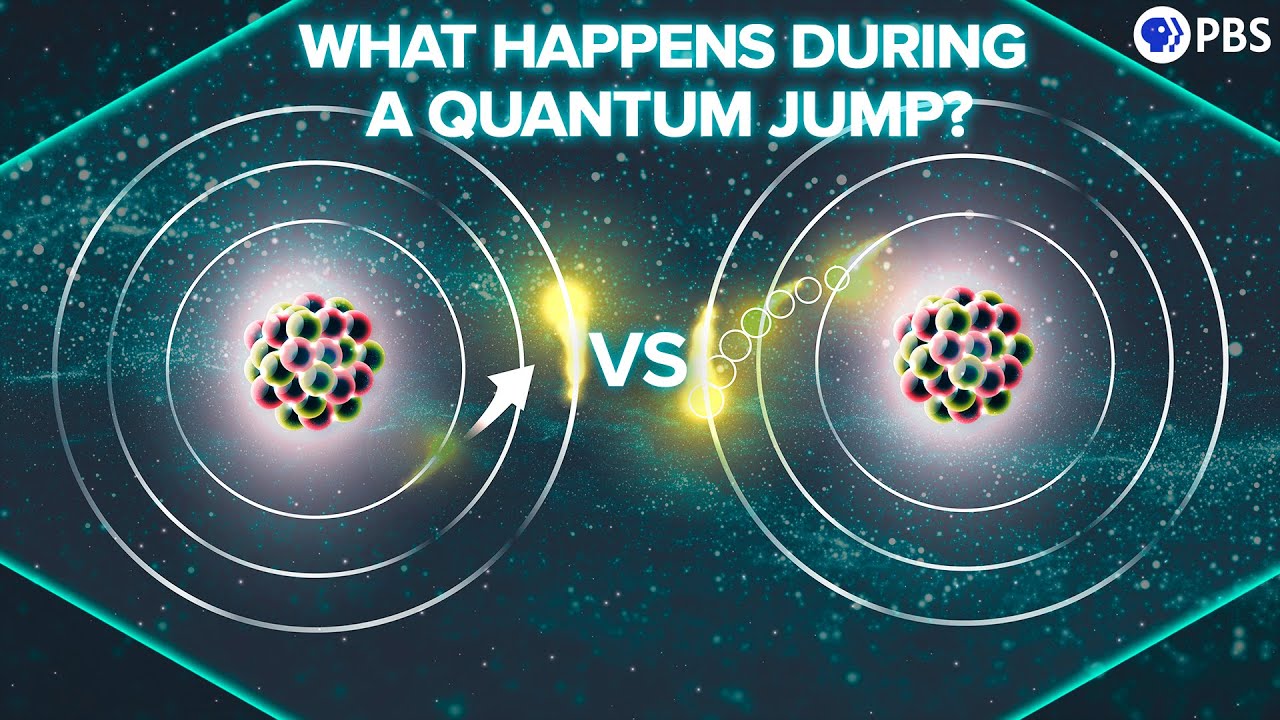
What Happens During a Quantum Jump?
Keywords
Summary
98 words
Critical Evaluation
Value of the Information & Strength of the Argument
The video provides a clear and engaging narrative of a complex topic, effectively using historical context and analogies to explain the physics. The argumentation is solid, presenting both sides of the debate and grounding the discussion in specific experimental results. The explanation of the 2019 experiment is particularly valuable, as it directly addresses the central question of whether quantum jumps are instantaneous. The video also does a good job of explaining the significance of the findings without oversimplifying the underlying physics.
Scientific Rigor, Source Quality, Title Accuracy
The video cites a specific 2019 Nature paper (Minev et al.) and correctly describes its findings. The historical references to Bohr, Schrödinger, and the 1986 experiments are accurate. The title accurately reflects the content. The video’s scientific rigor is high, though it necessarily simplifies some interpretations for a general audience. The description includes a correction to an erratum, showing attention to detail.
158 words
Title / Content Match
The title accurately reflects the content, which explores the nature of quantum jumps and recent experimental findings.
Quality & Reliability
8/10
The video presents a well-structured historical and experimental overview of quantum jumps, referencing a key 2019 Nature paper and explaining the experimental setup. The host is a physicist, and the content aligns with established scientific understanding, though it simplifies complex interpretations.
Key Moments
Markers derived by PSI from the transcript: the creator did not define chapters.
- Introduction to the quantum jump debate and the question of what happens during a jump.
- Bohr's 1913 model and the quantization of energy levels.
- Schrödinger's objections to quantum jumps and his wave-based alternative.
- 1986 experiments observing quantum jumps in single atoms.
- Explanation of the 2019 experiment with superconducting circuits.
- Findings: quantum jumps are continuous and predictable, and can be reversed.
- Discussion of the Quantum Zeno Effect and the ongoing debate between randomness and determinism.
Cited Sources
- To Catch and Reverse a Quantum Jump Mid-Flight — The 2019 Nature paper describing the experiment that observed and reversed quantum jumps in superconducting circuits.
- PBS Space Time Patreon — Support page for the show.
- PBS Space Time Merch Store — Merchandise store for the show.
- PBS Space Time Mailing List — Sign-up for episode notifications.
Concurring Sources
- To Catch and Reverse a Quantum Jump Mid-Flight — The primary experimental paper cited in the video, which supports the claim that quantum jumps are continuous and predictable.
External References
Contribution & Novelties
The video synthesizes historical and modern experimental results to present a nuanced view of quantum jumps, showing that they are not instantaneous but continuous, and that their onset can be predicted. It also highlights the ongoing debate between deterministic and random interpretations, and introduces the Quantum Zeno Effect as a potential explanation.
Pour aller plus loin :
- Quantum Zeno effect — A phenomenon where frequent measurement can inhibit quantum transitions, relevant to the video’s discussion.
- Copenhagen interpretation — The standard interpretation of quantum mechanics, which the video discusses in the context of quantum jumps.
- Schrödinger equation — The fundamental equation of quantum mechanics, which describes the continuous evolution of quantum states, as opposed to the discontinuous jumps.
- Superconducting quantum computing — The technology used in the 2019 experiment, which is also a leading approach for building quantum computers.
138 words
Radar Profile
The radar profile shows a well-balanced video with high scores across all dimensions, indicating a strong combination of information density, technical depth, and reliability. The slightly lower score in 'niveau_technique' reflects the need to simplify complex concepts for a general audience.
💬 Positif. Sur les 30 commentaires analysés, le public est très enthousiaste et apprécie la clarté de l'explication, avec de nombreux commentaires humoristiques et des références à la série 'Quantum Leap'.