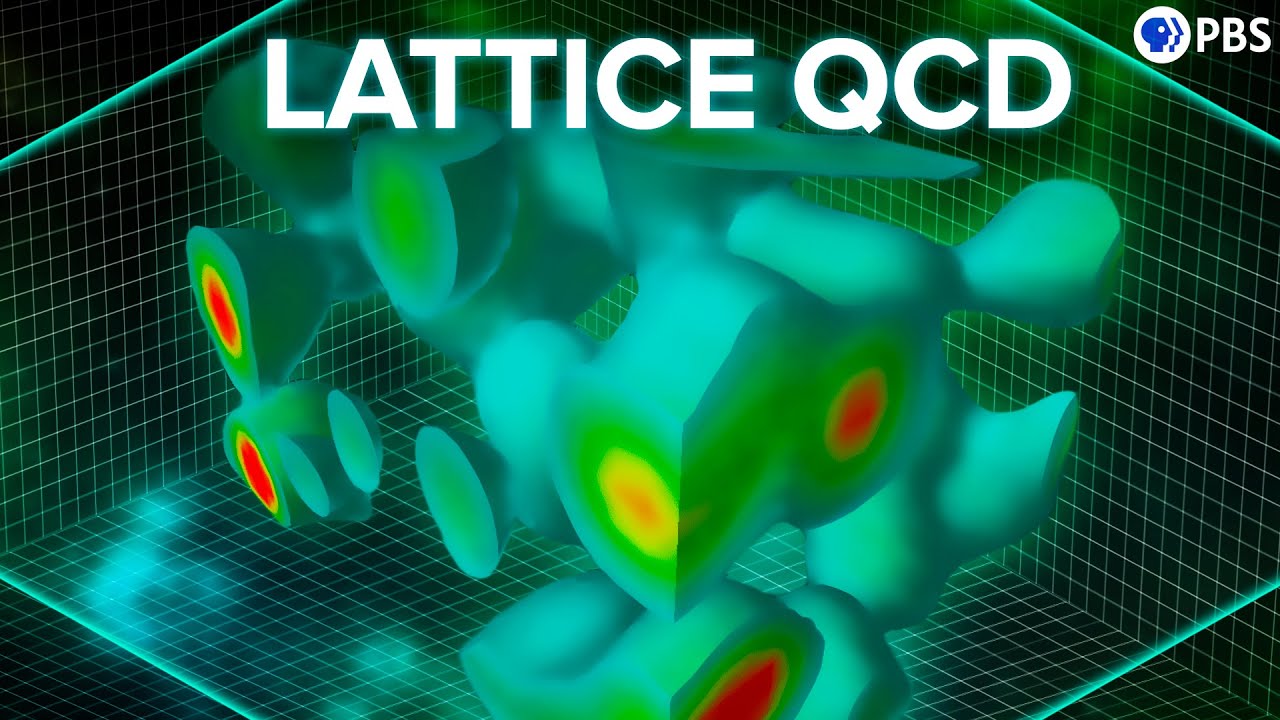
What Happens Inside a Proton?
Keywords
Summary
130 words
Critical Evaluation
Value of the Information & Strength of the Argument
The video provides a clear and compelling explanation of a complex topic, building from the basics of QED to the necessity of lattice QCD. The argumentation is solid, using analogies and step-by-step reasoning to justify each computational trick. It effectively conveys the value of these simulations in testing QCD and understanding the nature of quantum fields.
Scientific Rigor, Source Quality, Title Accuracy
The scientific rigor is high, with accurate descriptions of the physics and computational methods. The video references historical work (Ken Wilson, 1974) and modern applications (muon g-2), though it does not cite specific papers. The title accurately reflects the content. The comments are overwhelmingly positive, with viewers praising the clarity and depth of the explanation.
126 words
Title / Content Match
The title accurately reflects the content, which explores the internal structure of protons and how it is simulated using lattice QCD.
Quality & Reliability
9/10
High-quality explanation of lattice QCD, grounded in established physics, with clear reasoning and references to historical developments (Wilson, 1974) and modern applications (muon g-2). The content is accurate and well-structured, though it simplifies some aspects for a general audience.
Key Moments
Markers derived by PSI from the transcript: the creator did not define chapters.
- Introduction to the challenge of simulating a proton and the complexity of QCD.
- Explanation of Feynman diagrams and why they work for QED but not QCD.
- Introduction to lattice QCD and the need to discretize spacetime.
- Explanation of Monte Carlo sampling and Wick rotation.
- Discussion of results and implications, including the muon g-2 prediction.
Cited Sources
- PBS Donation Page — Support the show
- Space Time Mailing List — Get episode notifications
- Space Time Library Search — Search all episodes
- Space Time Merch Store — Merchandise
- End Credits Music by J.R.S. Schattenberg — Music credit
Concurring Sources
- Lattice QCD — Wikipedia article confirming the method and its history.
- Quantum chromodynamics — Wikipedia article on QCD, the theory discussed.
Contribution & Novelties
The video provides an accessible yet detailed introduction to lattice QCD, a topic rarely covered in popular science. It demystifies the computational techniques and explains why they are necessary, offering a unique perspective on how physicists test QCD.
Pour aller plus loin :
- Lattice QCD — Overview of the method and its applications.
- Quantum chromodynamics — Background on the theory of the strong force.
- Monte Carlo method — General computational technique used in lattice QCD.
- Wick rotation — Mathematical transformation used to simplify path integrals.
- Feynman diagram — Visual representation of particle interactions.
93 words
Radar Profile
The radar profile shows high scores across all dimensions, indicating a well-balanced and reliable video. The strength lies in the quality and quantity of information, with a slightly lower technical level due to the accessible presentation.
💬 Très positif. Sur les 30 commentaires analysés, les spectateurs expriment une admiration unanime pour la clarté de l'explication et la qualité pédagogique, certains soulignant des éclairages nouveaux même pour des physiciens expérimentés.