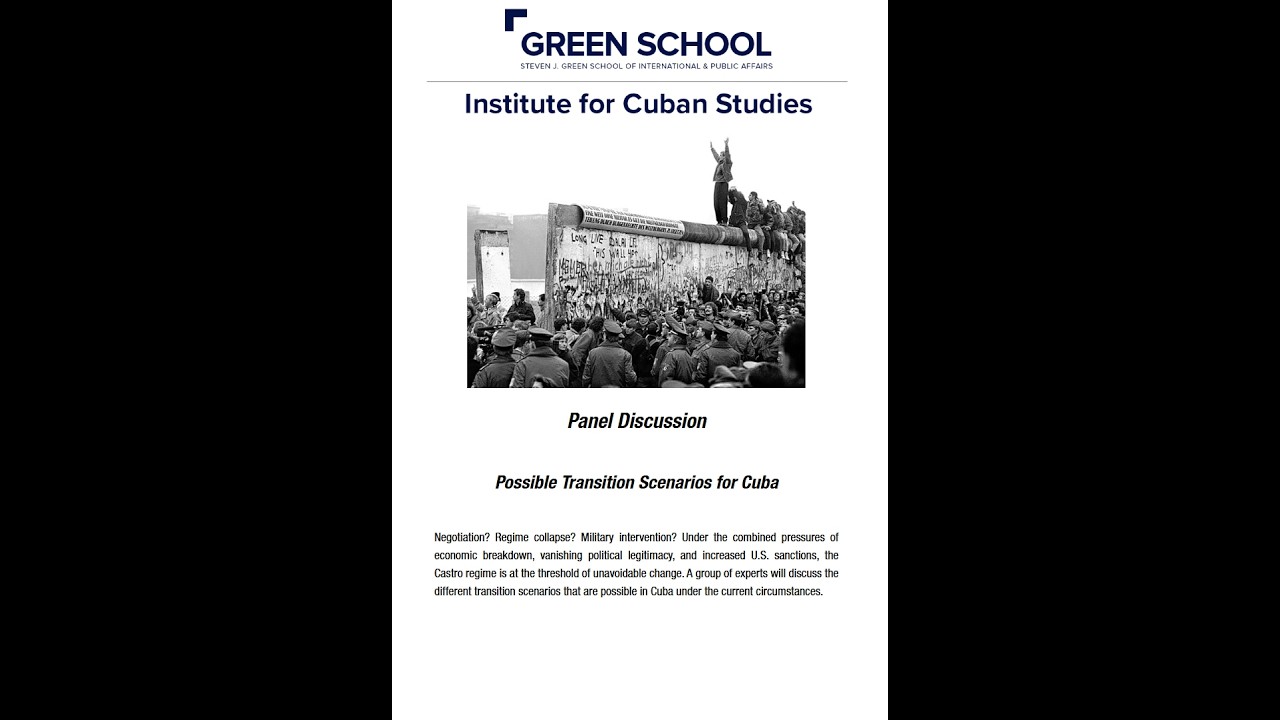
Possible Transition Scenarios for Cuba
Keywords
Summary
165 words
Critical Evaluation
Value of the Information & Strength of the Argument
The value of the information is high, as it provides a multi-perspective analysis of a complex geopolitical situation, drawing on recent events and policy documents. The argumentation is generally solid, with each panelist presenting structured scenarios and supporting them with references to current events, such as the indictment of Raul Castro, the deployment of a carrier strike group, and the European Union’s review of the PDCA. However, the arguments are inherently speculative and rely on expert interpretation rather than empirical evidence. The panelists acknowledge uncertainty and differing viewpoints, which adds to the credibility of the discussion. The presentation is well-organized, with clear scenario frameworks, but the lack of a Q&A segment in the transcript limits the depth of critical engagement.
Scientific Rigor, Source Quality, Title Accuracy
The scientific rigor is moderate to high, with panelists referencing specific reports, policy documents, and public statements. The sources cited include the report ‘Cuba on the threshold of change’ by the Fedman Foundation for Freedom, the PDCA review, and statements by US officials. However, the discussion is largely based on expert opinion and forward-looking analysis, which is not verifiable. The title accurately reflects the content, as the panel directly addresses possible transition scenarios. The adequacy between title and content is strong, with no significant mismatch.
220 words
Title / Content Match
The title accurately reflects the content, which is a panel discussion on potential transition scenarios for Cuba.
Quality & Reliability
7/10
Panel of experts with relevant academic and policy credentials, providing a structured analysis of possible transition scenarios for Cuba. The discussion is grounded in current events and references to reports and policy documents, but relies heavily on expert interpretation and forward-looking speculation, with limited verifiable data.
Key Moments
Markers derived by PSI from the transcript: the creator did not define chapters.
- Introduction of panelists and topic by the director of the Cuban Research Institute.
- Carolina presents the report 'Cuba on the threshold of change' and its central thesis.
- Carolina outlines the four scenarios: elite pact, induced erosion, institutional breakdown, and kinetic military action.
- Carolina discusses the anatomy of the collapse, including economic data and political prisoners.
- Brian presents his four pathways: humanitarian intervention, coercive action, internal fracture, and negotiated off-ramp.
- Brian analyzes the evolution of US framing of Cuba as a national security threat.
- Brian discusses the potential for internal fracture and the role of the military.
- Armando is introduced but his presentation is not shown in the transcript.
Cited Sources
- Cuba on the threshold of change (report) — Report by the Fedman Foundation for Freedom, presented by Carolina, outlining transition scenarios.
- PDCA (Political Dialogue and Cooperation Agreement) review — European Union's formal review of the agreement, mentioned as a factor in the transition scenarios.
- US indictment of Raul Castro — Mentioned as a significant legal action against the Cuban leadership.
Concurring Sources
- Cuba on the threshold of change (report) — The report's scenarios align with the panel's discussion.
- US State Department statements on Cuba — Public statements by US officials, such as Secretary Rubio, referenced in the discussion.
Dissenting Sources
- Cuban government statements — The Cuban government's official position would likely contradict the panel's characterization of the regime's fragility.
Contribution & Novelties
The video provides a timely and multi-faceted analysis of potential transition scenarios for Cuba, synthesizing European, US, and Latin American perspectives. It offers a structured framework for understanding the complex dynamics at play, including the role of the military-economic elite and the potential for elite pacts versus democratic change. The discussion updates earlier analyses with recent events, such as the US indictment of Raul Castro and the deployment of military assets.
Pour aller plus loin :
- Cuba–United States relations — Provides historical context for the current tensions.
- Cuban economic reform — Offers background on the economic challenges and reforms.
- Political transition — Conceptual framework for understanding transitions from authoritarian rule.
110 words
Radar Profile
The radar profile shows a balanced distribution across the four dimensions, with slightly higher scores for quantity of information and reliability, reflecting the expert panel's structured analysis. The lower score for technical level indicates that the content is accessible to a general audience, while still providing substantive geopolitical analysis.
💬 No comments were provided for analysis.