Les plantes alimentaires en France au fil de l'histoire
Food plants in France throughout history
Keywords
Summary
175 words
Critical Evaluation
Value of the Information & Strength of the Argument
The lecture provides valuable insights into the deep history of food plants, supported by concrete archaeological examples and methodological explanations. The argumentation is solid, based on empirical evidence from archaeological sites and genetic studies. The speaker effectively demonstrates how archaeobotany can reveal the origins and spread of cultivated plants, and how these introductions have shaped modern diets. The discussion of specific cases, such as the NewGlume wheat and the poppy, illustrates the complexity of plant domestication and diffusion. The talk is well-structured, progressing chronologically and thematically, and avoids oversimplification by acknowledging uncertainties and ongoing research.
Scientific Rigor, Source Quality, Title Accuracy
The scientific rigor is high, as the speaker is a recognized expert and presents established research. The sources are primarily archaeological findings and genetic analyses, which are appropriate for the topic. The title accurately reflects the content, which is a comprehensive overview of plant introductions in France. The lecture does not cite specific publications, but the information is consistent with current scientific knowledge. The description provides links to related conference playlists, which are useful for further exploration. Overall, the content is reliable and well-presented.
194 words
Title / Content Match
The title accurately reflects the content, which traces the introduction and cultivation of food plants in France from the Neolithic to the Roman period.
Quality & Reliability
8/10
The lecture is given by a CNRS researcher and archaeobotanist, presenting established scientific methods and findings. The content is well-structured, based on archaeological evidence and published research, with no obvious bias or misinformation.
Key Moments
Markers derived by PSI from the transcript: the creator did not define chapters.
- Introduction to the topic and the speaker.
- Definition of exotic species, acclimatization, and naturalization.
- Explanation of archaeobotany and carpology methods.
- Preservation modes: carbonization, waterlogging, mineralization.
- First wave of introductions: Neolithic crops from the Fertile Crescent.
- Discussion of the NewGlume wheat and its identification via ancient DNA.
- Second wave: Bronze Age introductions, including millets.
- Iron Age developments: viticulture and hemp.
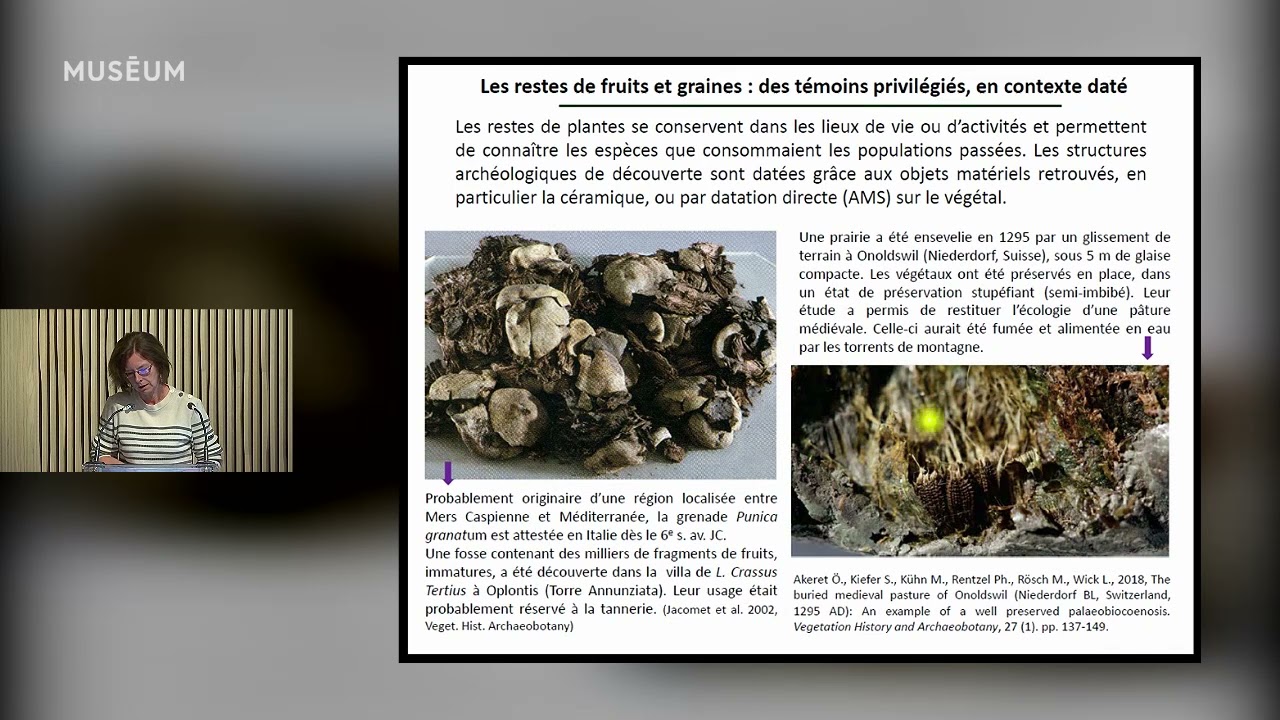
- Roman period: boom in horticulture and fruit trees.
- Conclusion: the historical construction of our food heritage.
Cited Sources
- Toutes les conférences — Playlist of all conferences from the Musée de l'Homme.
- Sur l'alimentation — Playlist on food-related topics.
Concurring Sources
- Archaeobotany (Wikipedia) — General reference on the discipline.
- Domestication (Wikipedia) — General concept of domestication.
Contribution & Novelties
The lecture provides a comprehensive synthesis of archaeobotanical knowledge on the introduction of food plants in France, highlighting the dynamic and multicultural origins of our diet. It offers a clear framework for understanding the successive waves of plant introductions and their cultural significance.
Pour aller plus loin :
- Archaeobotany (Wikipedia) — Overview of the discipline and its methods.
- Domestication (Wikipedia) — General concept of domestication, including plants.
- Neolithic Revolution (Wikipedia) — Context of the first agricultural communities.
- Fertile Crescent (Wikipedia) — Region of origin for many domesticated plants.
- Ancient DNA (Wikipedia) — Technique used to identify archaeological plant remains.
99 words
Radar Profile
The radar profile shows high scores in quantity and quality of information, with a strong technical level, indicating a dense and reliable scientific lecture. The overall reliability is high, consistent with the expert status of the speaker.