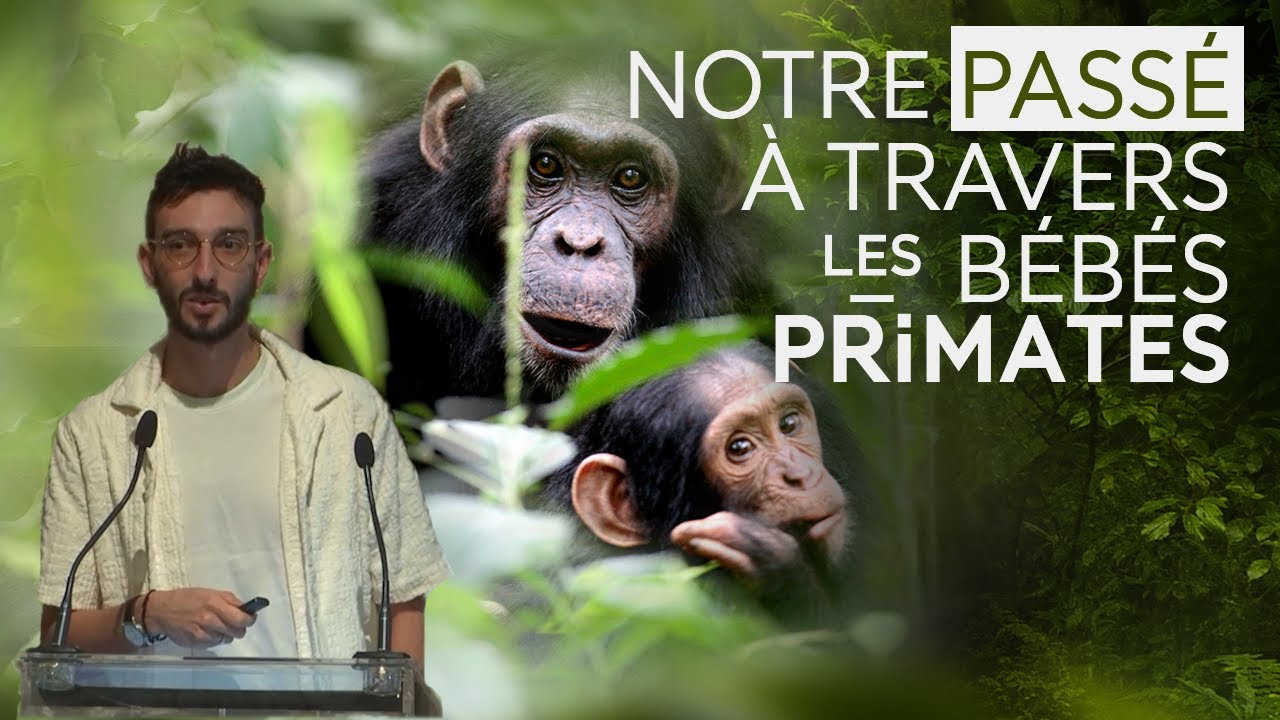
Comment les bébés primates nous éclairent sur nos origines ?
How primate babies shed light on our origins?
Keywords
Summary
208 words
Critical Evaluation
Value of the Information & Strength of the Argument
The value of the information is high, as it presents original research data from the speaker’s PhD, including quantitative measurements of grasping strength, limb proportions, and behavioral observations. The argumentation is solid, systematically linking morphology, performance, and behavior across developmental stages and between species. The speaker carefully explains the methodology, including the use of force sensors and morphometric analyses, and interprets the results in the context of evolutionary hypotheses. The comparative approach between mouse lemurs and baboons, which have different developmental trajectories, strengthens the conclusions about the functional significance of early grasping abilities.
Scientific Rigor, Source Quality, Title Accuracy
The scientific rigor is good: the research is based on direct measurements and observations, and the speaker references a study by Louis Specter on lemur carrying behavior. However, the description only provides a general link (bit.ly) without direct citations to the specific studies mentioned. The title accurately reflects the content, focusing on how primate development informs our origins. The talk is well-structured and the methodology is transparent, though the lack of explicit peer-reviewed references in the description slightly reduces the overall source quality.
191 words
Title / Content Match
The title accurately reflects the content, which focuses on how studying primate development can inform our understanding of human evolution.
Quality & Reliability
8/10
The conference presents original research from the speaker's PhD thesis, with detailed methodology and comparisons across species. The speaker is a doctoral researcher at Neomed (USA), and the talk is hosted by the Musée de l'Homme, a reputable institution. The content is well-structured and evidence-based, though it lacks peer-reviewed citations in the description.
Key Moments
Markers derived by PSI from the transcript: the creator did not define chapters.
- Introduction to biological anthropology and the comparative method.
- Explanation of the importance of studying development in primates.
- Introduction to the study species: mouse lemur and baboon.
- Results on mouse lemur grasping strength and limb proportions.
- Behavioral transitions in mouse lemur grasping techniques.
- Baboon grasping strength measurements and morphological analysis.
- Comparison between species and discussion of evolutionary implications.
- Role of infant carrying behavior in manual dexterity.
- Conclusions on the evolution of prehensile extremities.
Cited Sources
- En savoir plus (link in description) — Link provided in the video description for further information.
Concurring Sources
- Louis Specter's study on lemur carrying behavior — Referenced in the talk as a comparative study on 21 lemur species linking carrying mode to manual dexterity.
Contribution & Novelties
The talk provides original insights into the developmental origins of primate grasping abilities, showing that early strength and morphological adaptations are linked to locomotor and carrying behaviors. It challenges the assumption that adult morphology directly reflects adult behavior, highlighting the importance of ontogenetic trajectories.
Pour aller plus loin :
78 words
Radar Profile
The radar profile shows high scores in information quantity, quality, and reliability, with a slightly lower technical level, indicating a well-balanced and accessible scientific presentation.