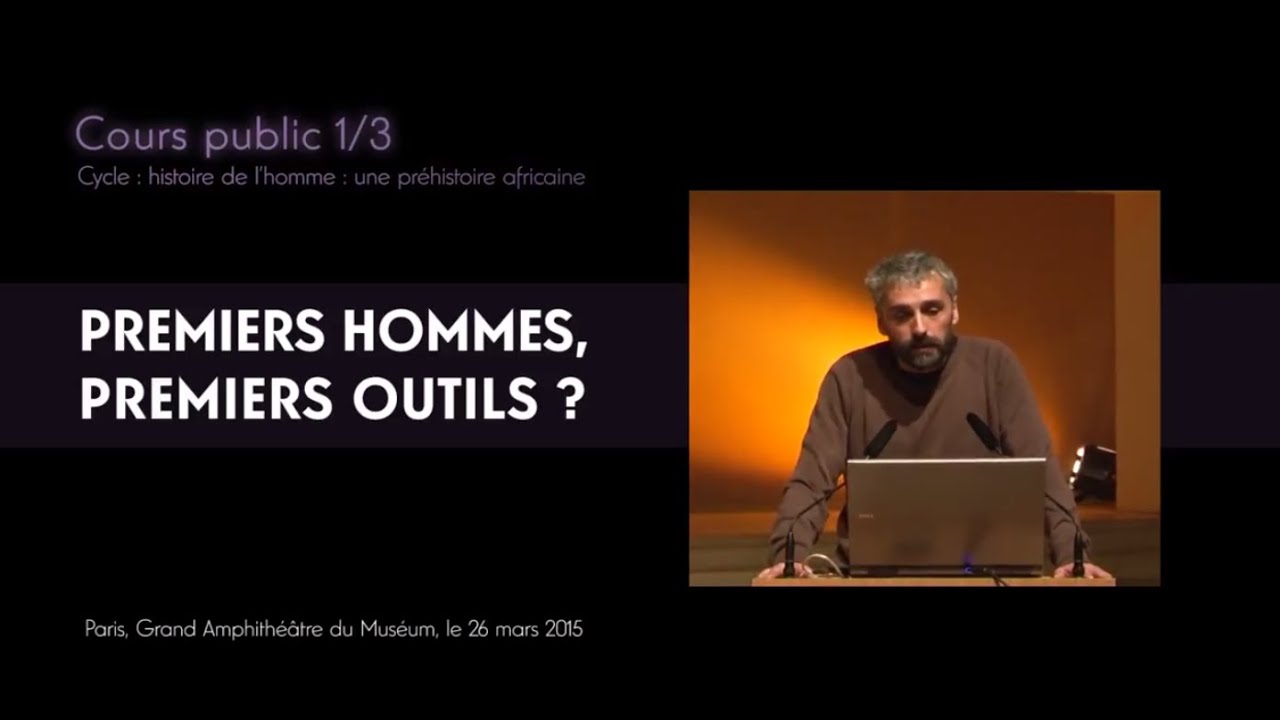
Premiers hommes, premiers outils ? (cycle Histoire de l’homme : une préhistoire africaine 1/3)
First men, first tools? (History of Man cycle: an African prehistory 1/3)
Keywords
Summary
182 words
Critical Evaluation
Value of the Information & Strength of the Argument
The lecture provides a solid and nuanced overview of the current state of knowledge on the first stone tools. It successfully deconstructs the common association between the first humans and the first tools by showing that tool use and manufacture are not exclusive to humans, and that the attribution of the oldest tools to a specific hominin species is based on historical biases. The argumentation is well-structured, moving from definitions to concrete examples, and the speaker is careful to point out the limits of archaeological data. The value of the information is high for a general audience, offering a clear and critical perspective on a complex topic.
Scientific Rigor, Source Quality, Title Accuracy
The lecture demonstrates scientific rigor by relying on well-established archaeological sites (Olduvai, Kada Gona) and by citing key researchers (Leakey, Pascal Picq). The speaker also acknowledges the limitations of the data and the existence of debates. However, the format does not allow for detailed source citation, and the lecture is more of a synthesis than a presentation of original research. The title accurately reflects the content, which is a critical examination of the link between the first humans and the first tools.
204 words
Title / Content Match
The title accurately reflects the content, which focuses on the question of the first tools and their association with the first humans, with a critical examination of this link.
Quality & Reliability
8/10
The lecture is given by a specialist (prehistorian, lecturer at MNHN) and presents a rigorous scientific approach, with a critical perspective on the history of discoveries and definitions. The content is based on established archaeological data and current research, but the format (oral lecture) limits the depth of source citation.
Key Moments
Markers derived by PSI from the transcript: the creator did not define chapters.
- Introduction: David Pleurdeau presents the series on African prehistory and the specific terminology used (Early, Middle, Later Stone Age).
- Discussion on the definition of a tool, with examples of tool use in animals (chimpanzees, crows) and the distinction between use and manufacture.
- Presentation of the Olduvai Gorge site and the 1959 discovery by the Leakeys, including the historical bias in attributing the tools to Homo habilis.
- Explanation of how archaeologists recognize intentionally flaked stones (stigmata, bulb of percussion, etc.) and the techniques used.
- Description of the oldest known stone tools (2.6 million years ago) at Kada Gona in Ethiopia, and the question of their makers.
Cited Sources
- Musée de l'Homme — The lecture is given at the Musée de l'Homme, and the speaker is a researcher at the MNHN.
Concurring Sources
- Oldowan — The lecture describes the Oldowan industry, which is well-documented in the literature.
- Homo habilis — The lecture discusses the attribution of the Oldowan tools to Homo habilis, a topic covered in many sources.
Dissenting Sources
- Tool use by animals — The lecture emphasizes the importance of animal tool use in challenging human uniqueness, which is a topic of debate in some circles.
Contribution & Novelties
The lecture offers a critical and nuanced perspective on the link between the first humans and the first tools, challenging the common assumption that tool-making is exclusive to humans. It highlights the historical biases in archaeological interpretation and the importance of considering animal tool use in understanding human evolution.
Pour aller plus loin :
- Oldowan — The earliest stone tool industry, named after Olduvai Gorge.
- Homo habilis — A species often associated with the Oldowan tools.
- Tool use by animals — Overview of tool use in non-human species.
88 words
Radar Profile
The radar profile shows high scores in quantity and quality of information, as well as in technical level, indicating a dense and well-structured lecture. The global reliability is also high, reflecting the speaker's expertise and the scientific rigor of the content.