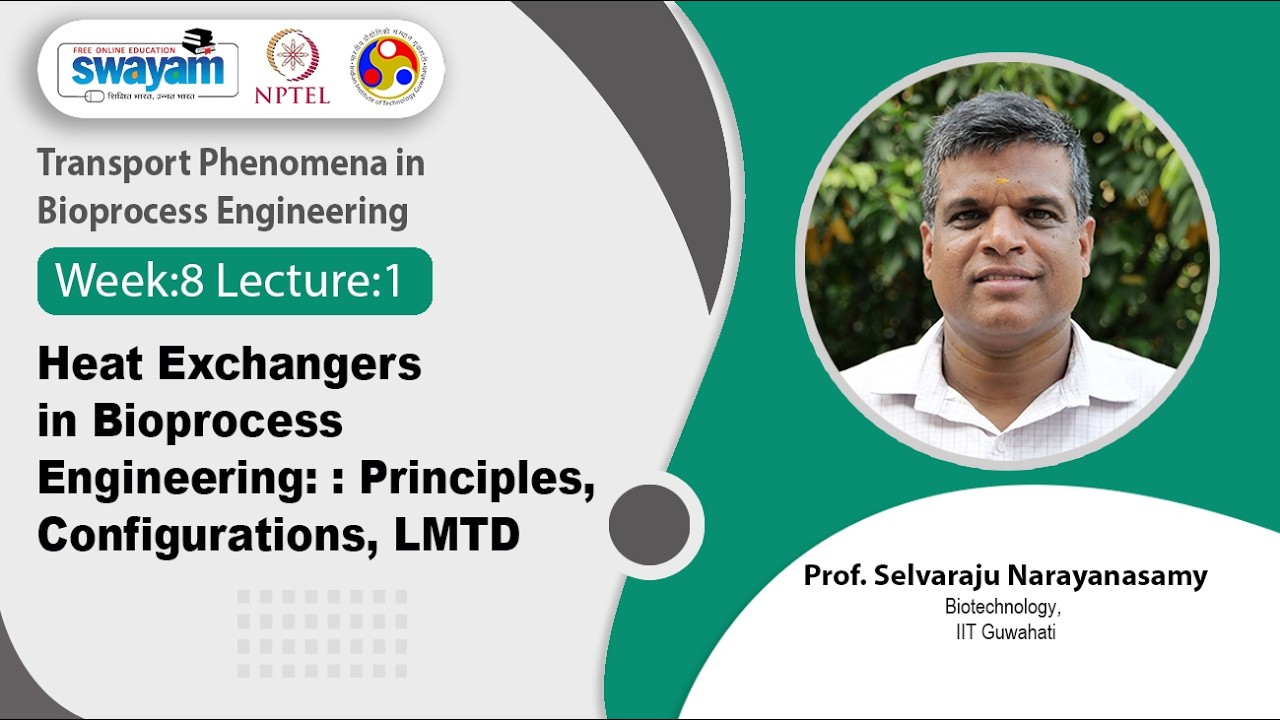
Lec 36: Heat Exchangers in Bioprocess Engineering: : Principles, Configurations, LMTD
Keywords
Summary
181 words
Critical Evaluation
Value of the Information & Strength of the Argument
The lecture provides a solid foundational overview of heat exchangers in bioprocess engineering, linking engineering principles to biological constraints (e.g., temperature sensitivity of enzymes and microbes). The argumentation is logical, moving from basic principles to specific configurations and then to design calculations. The worked example effectively illustrates the application of LMTD and correction factors, reinforcing the theoretical concepts. The value lies in its educational clarity for beginners, though it lacks depth in advanced design considerations or comparative analysis of different exchanger types.
Scientific Rigor, Source Quality, Title Accuracy
The content is scientifically rigorous, presenting standard engineering principles (LMTD, heat transfer coefficients) accurately. The source is an official NPTEL course by an IIT professor, lending credibility. The title accurately reflects the content. The lecture is well-structured but the transcription quality is poor, with many errors that could confuse viewers. No external sources are cited within the lecture, but the course materials are available online.
162 words
Title / Content Match
The title accurately reflects the content, which covers heat exchanger principles, configurations, and LMTD in the context of bioprocess engineering.
Quality & Reliability
7/10
The lecture is part of a formal NPTEL course by an IIT professor, providing structured educational content. The scientific principles (LMTD, heat transfer) are standard and correctly presented, with a worked example. However, the transcription contains numerous speech-to-text errors and the presentation is somewhat disorganized, with occasional repetitions and unclear explanations, which slightly detracts from clarity and precision.
Key Moments
Markers derived by PSI from the transcript: the creator did not define chapters.
- Introduction and learning objectives
- Importance of heat exchangers in bioprocess engineering
- Basic principle of heat transfer (convection-conduction-convection)
- Classification of heat exchangers: double pipe, shell and tube, cross flow
- Double pipe heat exchanger: construction, working, advantages, limitations
- Shell and tube heat exchanger: components, baffles, passes
- Cross flow heat exchanger and applications
- Introduction to LMTD and its applicability
- Correction factors for LMTD in multi-pass and cross flow
- Worked example: calculating heat transfer rate, LMTD, and overall heat transfer coefficient
Cited Sources
- Transport Phenomena in Bioprocess Engineering - Course Page — Course homepage with syllabus and materials.
- Transport Phenomena in Bioprocess Engineering - Playlist — YouTube playlist containing all lectures of the course.
Concurring Sources
- Heat exchanger - Wikipedia — General reference on heat exchangers, consistent with the lecture's content.
- Log mean temperature difference - Wikipedia — Reference on LMTD, matching the lecture's explanation.
Contribution & Novelties
The lecture provides a clear, structured introduction to heat exchangers specifically tailored for bioprocess engineering, emphasizing the importance of temperature control for biological systems. It effectively bridges chemical engineering principles with biotechnological applications. The worked example on LMTD correction factors is particularly useful for practical design.
Pour aller plus loin :
- Heat exchanger — General overview of heat exchanger types and applications.
- Log mean temperature difference — Detailed explanation of LMTD and its derivation.
- Shell and tube heat exchanger — In-depth look at shell and tube design and operation.
89 words
Radar Profile
The radar profile shows a balanced lecture with strong technical depth (8/10) and moderate information quantity (7/10). The overall reliability is good (7/10), reflecting the academic source, but the presentation quality and transcription errors slightly reduce the score. The lecture is well-suited for educational purposes.