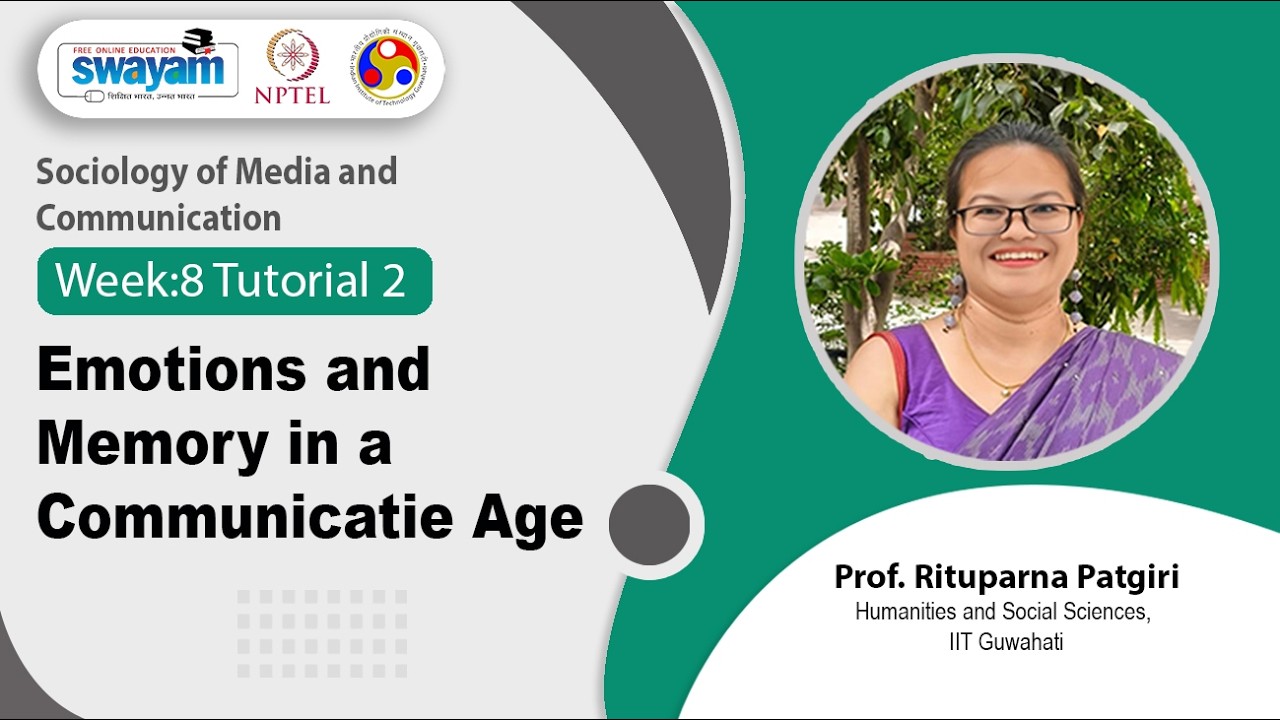
Tutorial 02: Emotions and Memory in a Communicatie Age
Keywords
Summary
130 words
Critical Evaluation
Value of the Information & Strength of the Argument
The lecture provides a valuable overview of key concepts in media theory and memory studies, such as collective memory, algorithmic memory, and performative emotions. It effectively connects theoretical frameworks to everyday digital practices, like sharing memories on Instagram or using emojis. The argumentation is coherent and builds logically from the historical context of digital communication to contemporary examples. However, the lecture could be strengthened by more concrete examples and empirical evidence to support its claims, as it relies heavily on general observations and the presenter’s own research anecdotes.
Scientific Rigor, Source Quality, Title Accuracy
The lecture is academically rigorous in its use of established theories, but it lacks explicit citations to specific studies or sources during the talk. The presenter mentions her own research on food and Instagram, but does not provide details or references. The title accurately reflects the content, which is a focused exploration of emotions and memory in the digital age. The lecture is part of a structured course, which adds to its credibility, but the lack of in-video citations limits its standalone reliability.
186 words
Title / Content Match
The title accurately reflects the content, which explores the intersection of emotions, memory, and digital communication.
Quality & Reliability
7/10
The lecture is grounded in established media theory and memory studies, referencing concepts like collective memory and algorithmic memory. However, it lacks explicit citations to specific studies or sources during the talk, and the presenter's own research is mentioned only anecdotally. The content is coherent and academically informed, but the lack of verifiable references within the video limits its standalone reliability.
Key Moments
Markers derived by PSI from the transcript: the creator did not define chapters.
- Introduction to the session on emotions and memory in a communicative age.
- Overview of the timeline of digital communication, from ARPANET to the pandemic.
- Discussion on how social media serves as an emotional archive, with examples of sharing life events.
- Explanation of the smartphone revolution and its impact on emotional recording and broadcasting.
- Introduction to key theoretical ideas: collective memory, performative emotions, and algorithmic influence.
- Exploration of poetic memory and its digital transformation through Instagram poetry and digital storytelling.
- Analysis of how emotions are played out on screens, from collective film watching to individual digital consumption.
- Discussion on algorithmic memory, including features like 'On This Day' and ethical concerns.
- Examination of digital culture and the commodification of emotions, with examples of relationship expectations online.
- Introduction to screen studies and digital humanities as interdisciplinary fields.
Cited Sources
- Course Preview: Sociology of Media and Communication — Course page for the NPTEL course this lecture is part of.
- Playlist: Sociology of Media and Communication — YouTube playlist containing all lectures of the course.
Concurring Sources
- Collective Memory — The lecture's discussion of memory as socially constructed aligns with this concept.
- Affect (psychology) — The lecture's exploration of emotions and their digital mediation relates to this psychological concept.
- Algorithmic curation — The lecture's analysis of algorithmic memory and its influence on emotions is consistent with this concept.
Dissenting Sources
- No discordant sources found — The lecture does not present conflicting viewpoints or sources.
Contribution & Novelties
The lecture offers a synthesis of existing theories on media, memory, and emotion, applying them to contemporary digital practices. Its novelty lies in the specific focus on ‘poetic memory’ and its digital evolution, as well as the discussion of algorithmic memory’s ethical implications. The presenter’s own research on food photography during the pandemic provides a unique empirical angle, though it is not detailed.
Pour aller plus loin :
- Collective Memory — Foundational concept for understanding how memory is socially constructed.
- Affect (psychology) — Relevant to the discussion of emotions and their expression.
- Algorithmic curation — Directly related to the lecture’s discussion of algorithmic memory and its effects.
107 words
Radar Profile
The radar profile shows a balanced performance across all dimensions, with slightly higher scores in information quantity and quality, reflecting the lecture's comprehensive coverage of the topic. The technical level is moderate, making it accessible to a general audience, while the overall reliability is solid due to the academic context.
💬 No comments were provided for analysis.