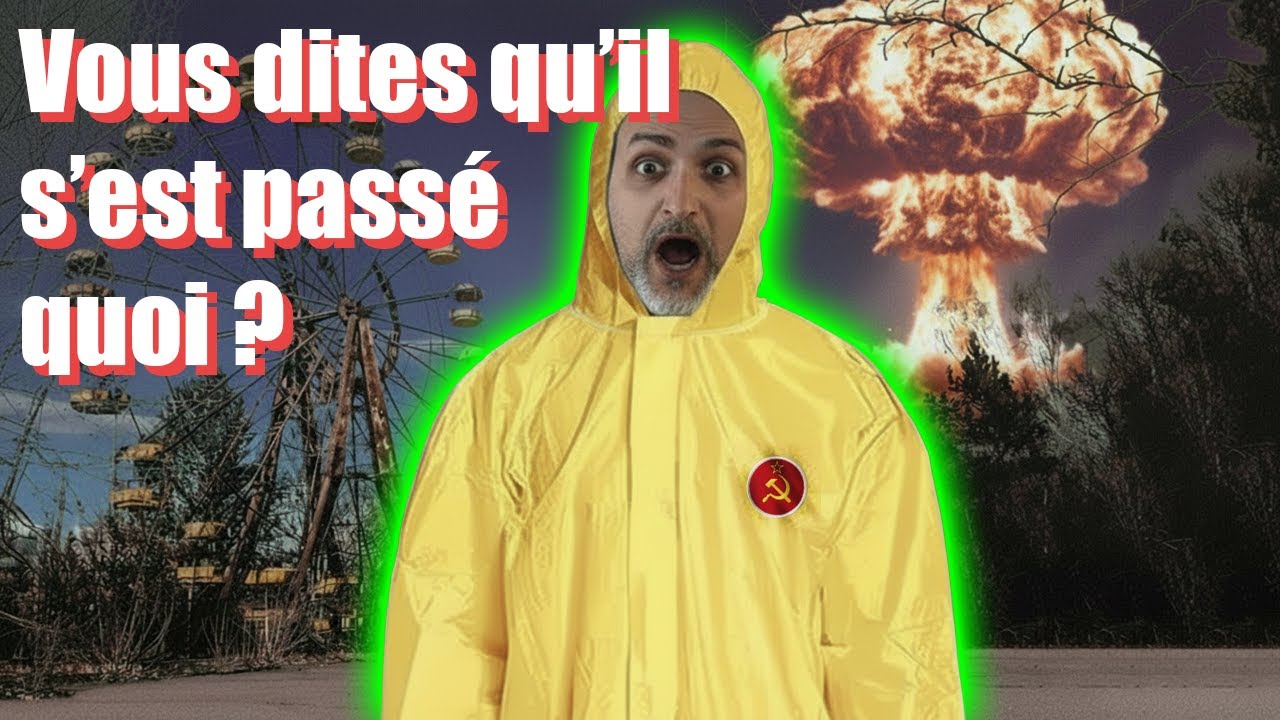
Ce qui est réellement arrivé à Tchernobyl
What actually happened to Chernobyl
Keywords
Summary
132 words
Critical Evaluation
Value of the Information & Strength of the Argument
The video provides substantial educational value by breaking down complex nuclear physics concepts into accessible explanations, using analogies and humor. The argumentation is well-structured, progressing from basic principles to the specific accident, and it supports its claims with references to scientific concepts (e.g., Faraday’s law, neutron absorption) and historical data (e.g., death rates per TWh). The presenter also addresses common misconceptions about nuclear waste and safety, citing natural reactors like Oklo as evidence. However, the argumentation is sometimes one-sided, particularly in its strong pro-nuclear stance, and it simplifies certain technical details, which could lead to misunderstandings.
Scientific Rigor, Source Quality, Title Accuracy
The video demonstrates a good level of scientific rigor, with accurate explanations of nuclear fission, reactor design, and the Chernobyl accident sequence. It references external sources, such as a video on Maxwell’s equations and the work of Jean-Marc Jancovici, though the latter is not directly linked. The title accurately reflects the content, which is a detailed account of the Chernobyl disaster. The video does not cite specific scientific papers or official reports, but it relies on well-established knowledge. Some technical inaccuracies were pointed out by commenters, such as the number of fuel rods and the recycling rate, which slightly detract from its precision. Overall, the content is reliable for a general audience, but experts may note simplifications.
228 words
Title / Content Match
The title accurately reflects the content, which focuses on the events and causes of the Chernobyl disaster.
Quality & Reliability
8/10
The video provides a detailed and generally accurate explanation of nuclear power plant operation and the Chernobyl accident, supported by references to scientific concepts and historical facts. Minor simplifications and a few technical inaccuracies (e.g., number of fuel rods, recycling rate) are noted, but the overall scientific rigor is high for a popular science format.
Chapters
- Sponsor
- Introduction
- Générique
- Les centrales hydro-électriques
- Les centrales thermiques
- Les centrales nucléaires
- Les réacteurs nucléaires
- Les absorbeurs de neutrons
- Les déchets nucléaires
- Tchernobyl
- Le 25 avril 1986 à 8h
- Le 25 avril 1986 à 16h
- Le 26 avril 1986 à minuit
- une heure du matin
- à 1h23 début du test
- à 1h23 et 45 sec
- Conclusion
- Générique de fin
Cited Sources
- NordVPN — Sponsor link mentioned in the video description.
- e-penser Twitch — Link to the creator's Twitch channel.
- Video on Maxwell's equations — Referenced in the video when discussing Faraday's law.
Concurring Sources
- Chernobyl disaster — Provides a comprehensive account of the accident, aligning with the video's narrative.
- RBMK — Details the reactor design and its flaws, consistent with the video's explanation.
Dissenting Sources
- Comment on recycling rate — A commenter pointed out that the claim of recycling 96% of nuclear fuel is misleading, as only a small fraction is actually recycled into new fuel.
Contribution & Novelties
The video offers a comprehensive and engaging explanation of the Chernobyl disaster, combining fundamental physics with a detailed narrative of the events. It stands out for its clear pedagogical approach and its ability to make complex topics accessible. The video also provides a balanced perspective on nuclear energy, acknowledging both its safety record and the importance of proper management.
Pour aller plus loin :
- Chernobyl disaster — Provides a detailed overview of the accident, including causes and aftermath.
- RBMK — Explains the design and characteristics of the RBMK reactor type.
- Nuclear fission — Covers the fundamental physics behind nuclear fission.
- Oklo natural nuclear reactor — Discusses the natural nuclear fission reactors discovered in Gabon.
- Nuclear power safety — Reviews safety measures and incidents in nuclear power.
126 words
Radar Profile
The radar profile shows high scores in quantity of information and technical level, indicating a dense and detailed video. The quality of information and reliability are also strong, though slightly lower, reflecting minor inaccuracies. Overall, the video is a robust educational resource.
💬 Très positif. Sur les 30 commentaires analysés, la grande majorité exprime une forte appréciation, saluant la qualité pédagogique, l'humour et la précision du contenu, avec quelques précisions techniques constructives.