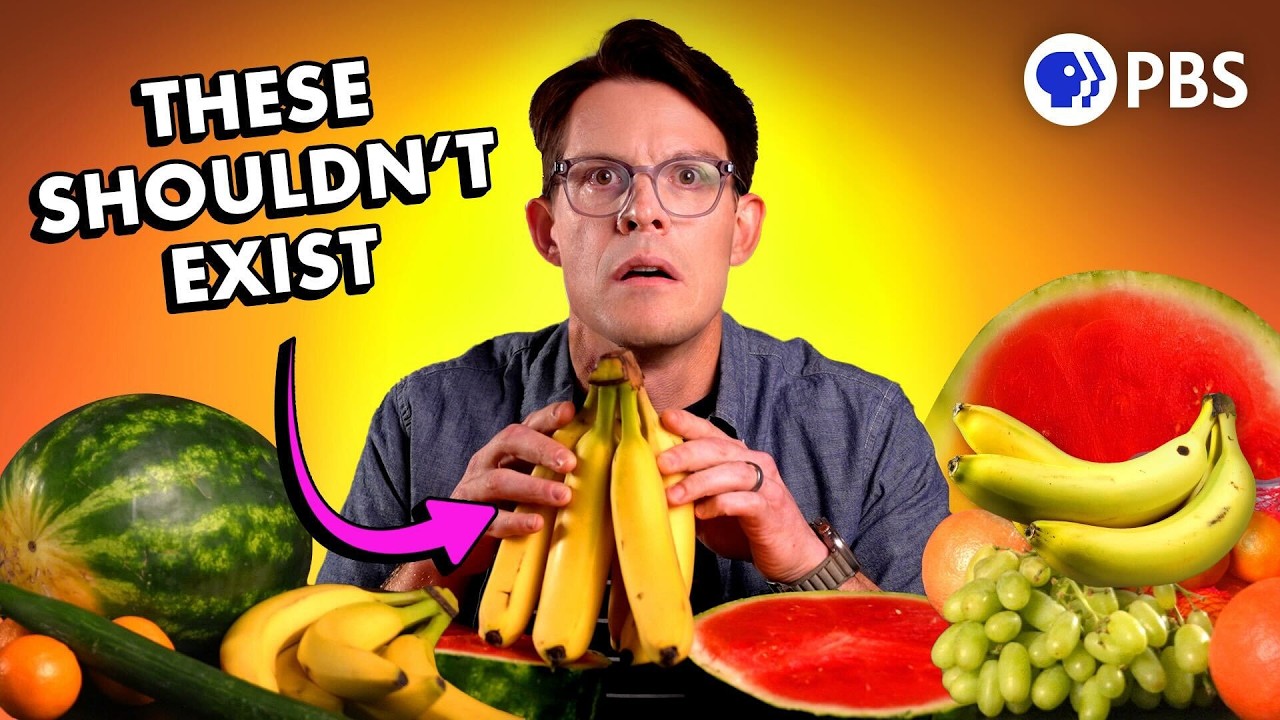
Why Seedless Fruit Is a Disaster Waiting To Happen
Keywords
Summary
158 words
Critical Evaluation
Value of the Information & Strength of the Argument
The video provides valuable information about the biology and history of seedless fruits, explaining complex concepts like parthenocarpy and polyploidy in an accessible way. The argumentation is solid, using historical examples like the Gros Michel banana to illustrate the risks of genetic uniformity. The video effectively builds a case for the importance of genetic diversity in agriculture, supported by expert commentary and visual demonstrations. The narrative is engaging and logically structured, moving from the ‘how’ to the ‘why’ of seedless fruits, and culminating in a call for caution about our reliance on clones.
Scientific Rigor, Source Quality, Title Accuracy
The video demonstrates scientific rigor by accurately explaining genetic mechanisms and citing historical events. It references the Panama disease outbreak and the shift from Gros Michel to Cavendish bananas, which are well-documented. The title accurately reflects the content, focusing on the potential disaster of seedless fruit dependence. The video also mentions CRISPR and public perception of GMOs, grounding its discussion in current scientific and societal debates. The content is well-sourced, though specific citations are not provided in the video itself; the description includes a link to PBS for support, but no direct scientific references are listed.
204 words
Title / Content Match
The title accurately reflects the video's content, which explores the paradox and risks of seedless fruits, including their dependence on human intervention and vulnerability to disease.
Quality & Reliability
8/10
The video presents scientifically accurate information about parthenocarpy, stenospermocarpy, polyploidy, and the history of banana cultivation, supported by expert commentary and references to real events. The content is well-researched and clearly explained, though it simplifies some complex genetic concepts for a general audience.
Key Moments
Markers derived by PSI from the transcript: the creator did not define chapters.
- Introduction to seedless fruits and the paradox they present.
- Explanation of parthenocarpy and the discovery of the Navel orange.
- Discussion of stenospermocarpy and the creation of seedless watermelons through polyploidy.
- Introduction of the concept of 'maintenance trap' and the dependence of seedless plants on humans.
- History of the Gros Michel banana and its demise due to Panama disease.
- Current threats to Cavendish bananas and other seedless crops, and the potential role of CRISPR.
- Conclusion on the importance of genetic diversity and the future of our food supply.
Cited Sources
- Support PBS — Link in video description to support PBS stations, mentioned at the end of the video.
Concurring Sources
- Parthenocarpy — The video's explanation of seedless fruit development aligns with the scientific definition of parthenocarpy.
- Panama disease — The video's account of the Gros Michel banana's decline due to Panama disease is consistent with historical records.
Dissenting Sources
- GMO safety perceptions — The video mentions that less than one-third of Americans feel GMO food is safe, but some studies and public opinion polls may show varying levels of acceptance, indicating a complex and evolving public perception.
Contribution & Novelties
The video offers a comprehensive and engaging overview of seedless fruits, connecting biological mechanisms to agricultural practices and historical events. It provides a clear explanation of how seedless fruits are created and why they are vulnerable, using the banana as a case study. The video also introduces the concept of a ‘maintenance trap’ to describe our dependence on these crops, adding a novel perspective.
Pour aller plus loin :
- Parthenocarpy — Wikipedia article explaining the development of fruit without fertilization.
- Panama disease — Wikipedia article on the fungal disease that devastated Gros Michel bananas.
- Cavendish banana — Wikipedia article on the current dominant banana variety and its susceptibility to disease.
- Polyploidy — Wikipedia article on the condition of having more than two sets of chromosomes, used to create seedless watermelons.
130 words
Radar Profile
The radar profile shows high scores in information quantity and quality, reflecting the video's comprehensive and accurate content. The technical level is moderate, suitable for a general audience, while the overall reliability is strong, supported by well-documented examples. This indicates a well-balanced and informative science communication piece.
💬 Positif. Sur les 30 commentaires analysés, les spectateurs expriment un intérêt marqué pour le sujet, partagent des anecdotes personnelles sur la culture de fruits avec pépins, et discutent des implications éthiques et pratiques des fruits sans pépins, avec une majorité de retours favorables et constructifs.