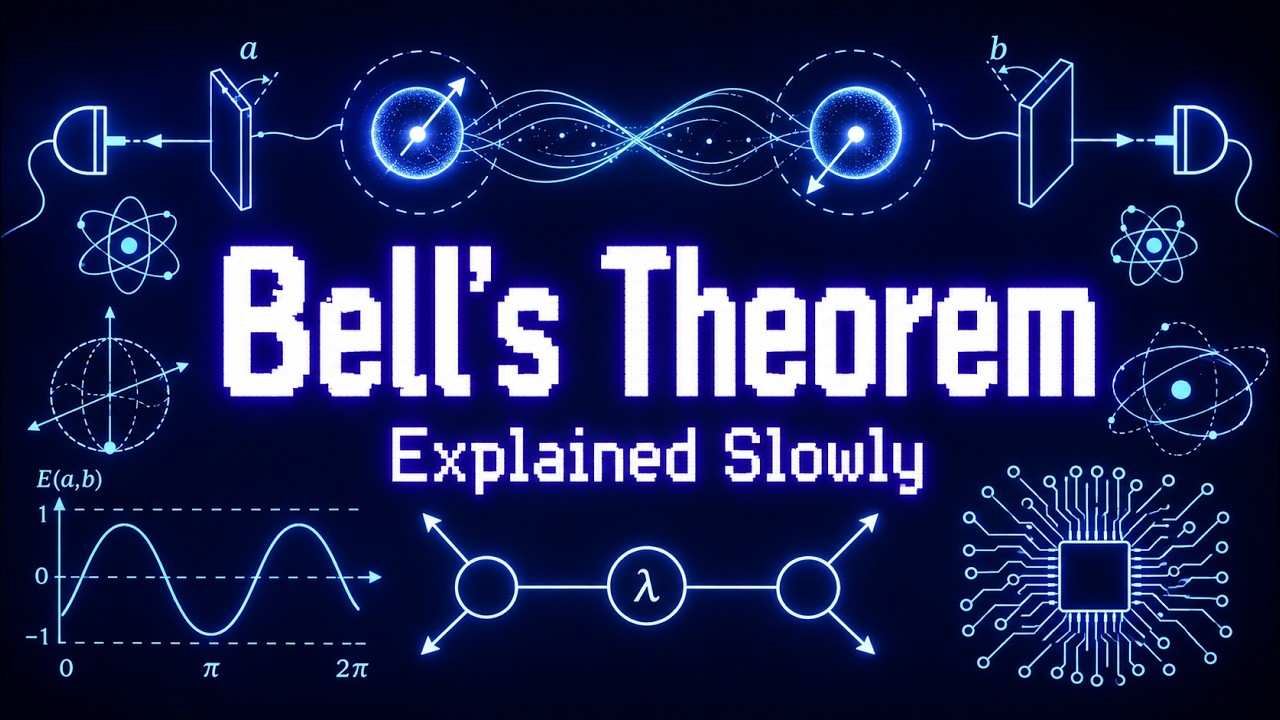
Every Confusing Thing About Bell's Theorem Explained Slowly (For Sleep)
Keywords
Summary
132 words
Critical Evaluation
Value of the Information & Strength of the Argument
The video provides substantial value by demystifying a complex topic and presenting it in an accessible, narrative-driven format. The argumentation is logically sound, building from historical context to the core theorem and its experimental verification. It effectively uses analogies (e.g., the coin, instruction sets) to convey abstract concepts. The explanation of Bell’s inequality, while simplified, captures the essential logic without misrepresenting the physics. The video also fairly presents different interpretations, such as Bohmian mechanics, showing a balanced perspective. However, it does not delve into the mathematical details, which limits its depth for a more advanced audience.
Scientific Rigor, Source Quality, Title Accuracy
The video demonstrates strong scientific rigor by grounding its narrative in well-established historical facts and referencing key primary sources. The description includes links to Bell’s original paper, the Nobel Prize summary, the Stanford Encyclopedia of Philosophy, and a Nature paper on loophole-free tests, all of which are authoritative. The title accurately reflects the content and purpose of the video. The presentation is consistent with the scientific consensus on Bell’s theorem and its implications. The video does not overstate claims and appropriately notes the ongoing debates about interpretations.
198 words
Title / Content Match
The title accurately reflects the content: a slow, sleep-oriented explanation of Bell's theorem and its conceptual context.
Quality & Reliability
8/10
The video provides a historically accurate and conceptually sound explanation of Bell's theorem, referencing key papers and experiments. It avoids technical errors, though it simplifies some aspects for a general audience. The sources cited are authoritative (CERN, Nobel Prize, Stanford Encyclopedia, Nature).
Key Moments
Markers derived by PSI from the transcript: the creator did not define chapters.
- Introduction to the central question: does the moon exist when nobody looks?
- Historical context: the ultraviolet catastrophe and Planck's quantum hypothesis.
- Einstein's photoelectric effect and the birth of the photon concept.
- Bohr's model of the atom and the emergence of quantum mechanics in the 1920s.
- Heisenberg's matrix mechanics and Schrödinger's wave equation; the concept of superposition.
- Einstein's objections and the Copenhagen interpretation debate.
- The EPR paradox and the introduction of entanglement.
- John Bell's background and his 1964 paper.
- Explanation of Bell's inequality using the instruction set analogy.
- Experimental tests: John Clauser's early work and the locality loophole.
- Alain Aspect's experiments and modern loophole-free Bell tests.
- Interpretations: Bohmian mechanics, many-worlds, and the ongoing mystery.
Cited Sources
- John S. Bell — Original 1964 paper, CERN Document Server — The foundational paper presenting Bell's theorem.
- Nobel Prize — The Nobel Prize in Physics 2022 — Awarded for experiments with entangled photons, establishing the violation of Bell inequalities.
- Stanford Encyclopedia of Philosophy — Bell's Theorem — A comprehensive philosophical and physical overview of Bell's theorem.
- Nature — Loophole-free Bell inequality violation — A key experimental paper reporting a loophole-free violation of Bell's inequality.
Concurring Sources
- Bell's theorem - Wikipedia — Confirms the theoretical framework and experimental status of Bell's theorem.
- Quantum entanglement - Wikipedia — Supports the description of entanglement and its non-local correlations.
Dissenting Sources
- Bohmian mechanics - Wikipedia — While the video mentions Bohmian mechanics as a viable alternative, some physicists argue it is not a fully satisfactory resolution due to its non-locality and additional structure.
External References
Contribution & Novelties
The video’s original contribution lies in its pedagogical approach: it presents Bell’s theorem as a narrative, emphasizing the conceptual journey from Einstein’s objections to experimental verification, all within a sleep-friendly, slow-paced format. It effectively bridges the gap between popular science and technical accuracy, making a notoriously difficult topic accessible without sacrificing correctness.
Pour aller plus loin :
- Bell’s theorem - Wikipedia — A detailed overview of the theorem, its derivations, and experimental tests.
- Quantum entanglement - Wikipedia — Background on the phenomenon central to Bell’s theorem.
- EPR paradox - Wikipedia — The original thought experiment that motivated Bell’s work.
- Bohmian mechanics - Wikipedia — A non-local hidden variable theory that Bell himself considered seriously.
- CHSH inequality - Wikipedia — A practical form of Bell’s inequality used in experiments.
128 words
Radar Profile
The radar profile shows high scores in information quantity and quality, reflecting the video's comprehensive and accurate content. The technical level is moderate, indicating it is accessible to a general audience but still provides substantial depth. Overall reliability is strong, supported by authoritative sources and a balanced presentation.