UofM - MATH 2740 - Lecture 07 - Part 2 - SVD (theory)
Keywords
Summary
152 words
Critical Evaluation
Value of the Information & Strength of the Argument
The lecture provides a clear and rigorous proof of a fundamental theorem in linear algebra, which is essential for understanding SVD. The argumentation is logical and step-by-step, making the proof accessible. The instructor takes care to explain each manipulation, such as complex conjugation and transposition, and justifies why the dot product of a non-zero vector with its conjugate is non-zero. This adds value by reinforcing key concepts and techniques. The proof is self-contained, relying only on previously covered material, which strengthens its pedagogical value.
Scientific Rigor, Source Quality, Title Accuracy
The scientific rigor is high: the proof is mathematically correct and follows standard techniques. The instructor does not cite external sources, but this is typical for a lecture; the content is based on established mathematical knowledge. The title accurately reflects the content, as the lecture is indeed about SVD theory. No comments were provided, so no analysis of public reception is possible.
161 words
Title / Content Match
The title accurately reflects the content: the lecture focuses on the theoretical foundations of SVD, including the definition of singular values and the proof of real eigenvalues for symmetric matrices.
Quality & Reliability
8/10
The lecture provides a rigorous proof that real symmetric matrices have real eigenvalues, a foundational result for SVD. The explanation is mathematically sound and well-structured, though it is a single lecture without external citations.
Key Moments
Markers derived by PSI from the transcript: the creator did not define chapters.
- Introduction to the lecture and setup for SVD.
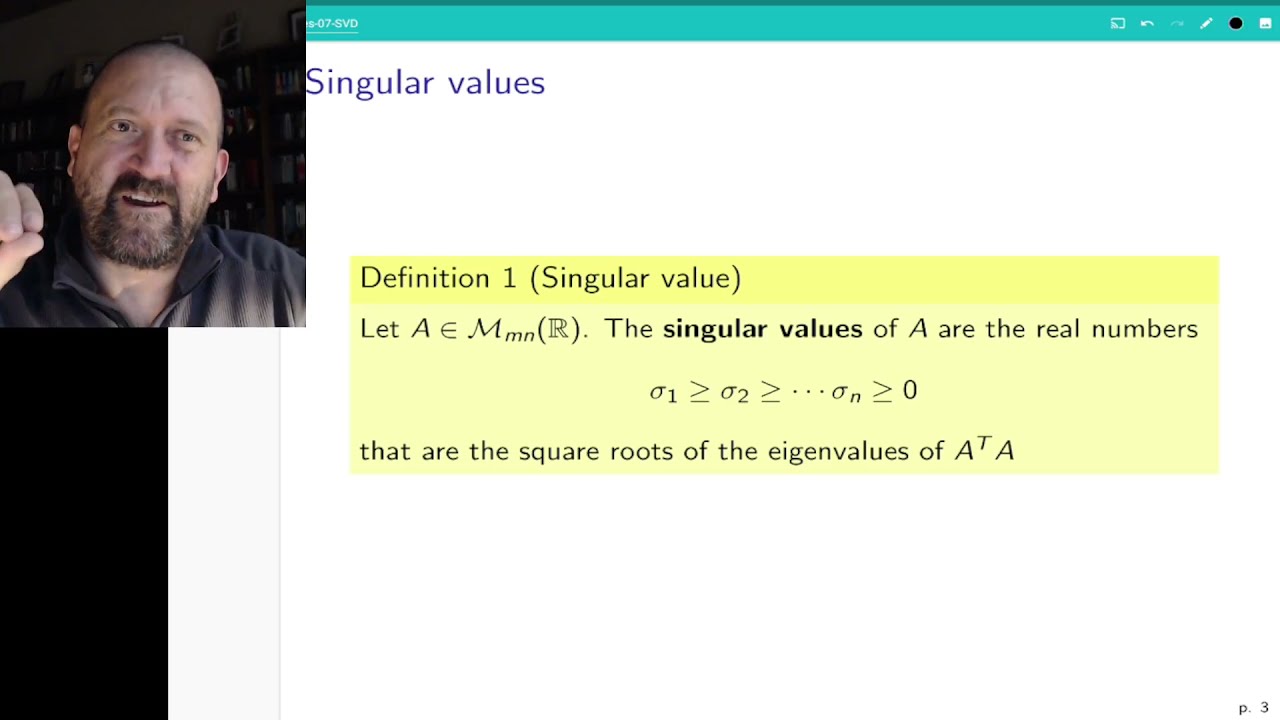
- Definition of singular values as square roots of eigenvalues of A^T A.
- Statement of the theorem: real symmetric matrices have real eigenvalues.
- Start of the proof using complex conjugation.
- Manipulation of the eigenvalue equation and transposition.
- Use of dot product to show lambda equals its conjugate.
- Conclusion of the proof and implications for SVD.
Contribution & Novelties
The lecture provides a clear and rigorous proof of a fundamental result in linear algebra, which is essential for understanding SVD. It bridges the gap between abstract theory and application by connecting eigenvalues of A^T A to singular values. The proof is presented in an intuitive manner, making it accessible to students.
Pour aller plus loin :
- Singular value decomposition - Wikipedia — Provides a comprehensive overview of SVD, including applications.
- Symmetric matrix - Wikipedia — Discusses properties of symmetric matrices, including real eigenvalues.
- Eigenvalues and eigenvectors - Wikipedia — Background on eigenvalues and eigenvectors.
95 words
Radar Profile
The radar profile shows high scores in quality of information, technical level, and reliability, with a slightly lower score in quantity of information due to the focused scope of the lecture. This indicates a technically deep but narrowly focused content.