HG Behavior - Dementia
Keywords
Summary
153 words
Critical Evaluation
Value of the Information & Strength of the Argument
The video provides a valuable introductory overview of the genetic basis of dementia, synthesizing key concepts in a clear and accessible manner. The argumentation is logically structured, moving from general prevalence to specific genetic mechanisms and pathologies. The lecturer effectively uses diagrams to illustrate complex processes like amyloid plaque formation and the role of dynein transport in Huntington’s disease. However, the argumentation is largely descriptive and lacks critical evaluation of the evidence. The lecturer presents information as established fact without discussing controversies or alternative hypotheses, which limits the depth of the scientific argument.
Scientific Rigor, Source Quality, Title Accuracy
The scientific rigor is moderate. The lecturer demonstrates familiarity with the field but does not cite specific studies or sources, making it difficult to verify claims. The information is generally accurate but simplified, and some statements are imprecise (e.g., ’ensemble dominant’ instead of ‘autosomal dominant’). The title accurately reflects the content, which is a focused discussion on dementia genetics. No comments were provided, so public reception cannot be assessed.
177 words
Title / Content Match
The title 'HG Behavior - Dementia' is concise and accurately reflects the content, which discusses the genetic basis of dementia.
Quality & Reliability
6/10
The content is a lecture-style overview of the genetic basis of dementia, presented by a professor with apparent expertise. It covers established concepts (e.g., early-onset vs late-onset Alzheimer's, APOE, Huntington's CAG repeats) but lacks citations to specific studies or sources. The information is generally accurate but simplified and occasionally imprecise (e.g., 'ensemble dominant' likely means 'autosomal dominant').
Key Moments
Markers derived by PSI from the transcript: the creator did not define chapters.
- Introduction to the topic of dementia and its genetic basis.
- Prevalence of Alzheimer's disease and projected increase to 50 million cases by 2050.
- Distinction between early-onset familial Alzheimer's and late-onset sporadic Alzheimer's.
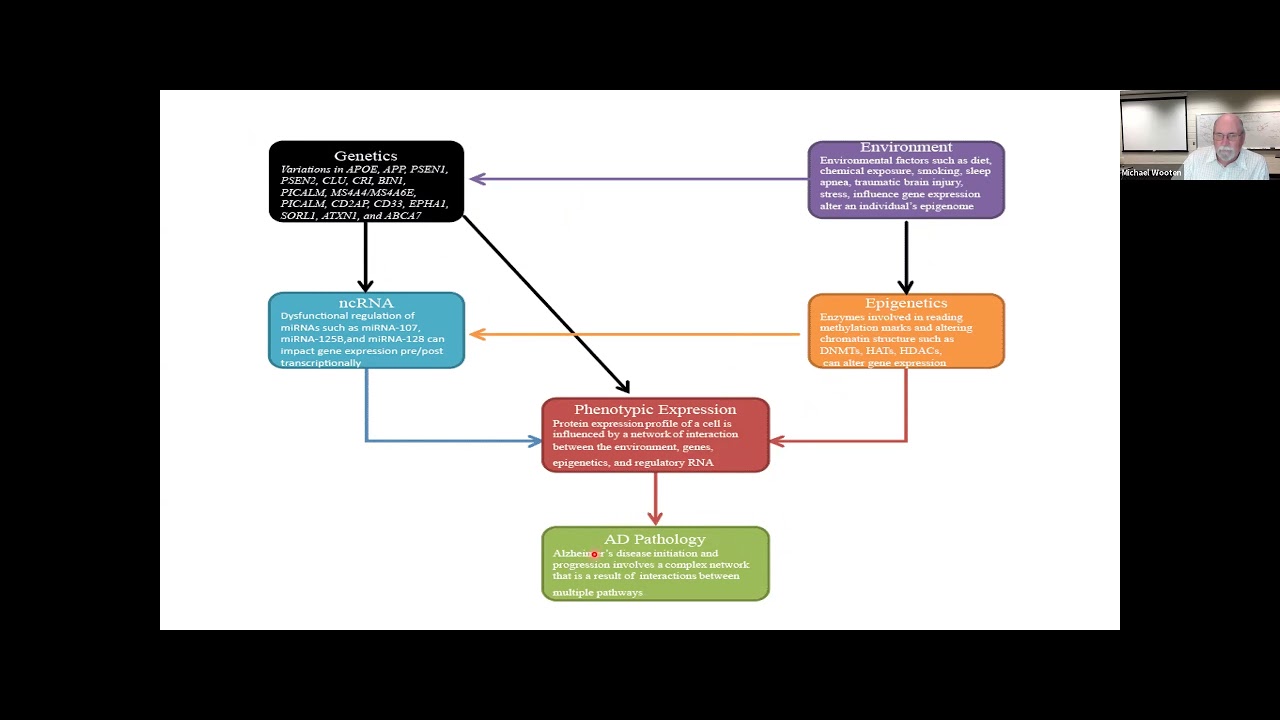
- Discussion of genetic risk factors and environmental influences, including APOE and epigenetic effects.
- Pathology of Alzheimer's: amyloid plaques, mitochondrial dysfunction, and neuronal death.
- Lack of definitive diagnostic tests and current treatment limitations.
- Introduction to Huntington's disease: genetics, CAG repeats, and symptoms.
- Comparison of Huntington's and Alzheimer's pathologies, emphasizing complexity.
Contribution & Novelties
The video offers a concise synthesis of the genetic basis of two major dementias, highlighting the contrast between monogenic (Huntington’s) and polygenic/complex (Alzheimer’s) inheritance. It underscores the multifactorial nature of late-onset Alzheimer’s, integrating genetic, epigenetic, and environmental factors. The lecturer’s emphasis on the lack of definitive diagnostics and treatments is a sobering reminder of the challenges ahead.
Pour aller plus loin :
- Alzheimer’s disease genetics — Overview of genetic risk factors and familial forms.
- Huntington’s disease — Detailed description of the disorder, including CAG repeat mechanism.
- APOE gene — Key genetic risk factor for late-onset Alzheimer’s.
- Epigenetics in neurodegeneration — Role of epigenetic modifications in dementia.
106 words
Radar Profile
The radar profile shows moderate scores across all dimensions, indicating a balanced but not exceptional video. The content is informative and technically sound, but lacks depth and source citations, resulting in a moderate overall rating.