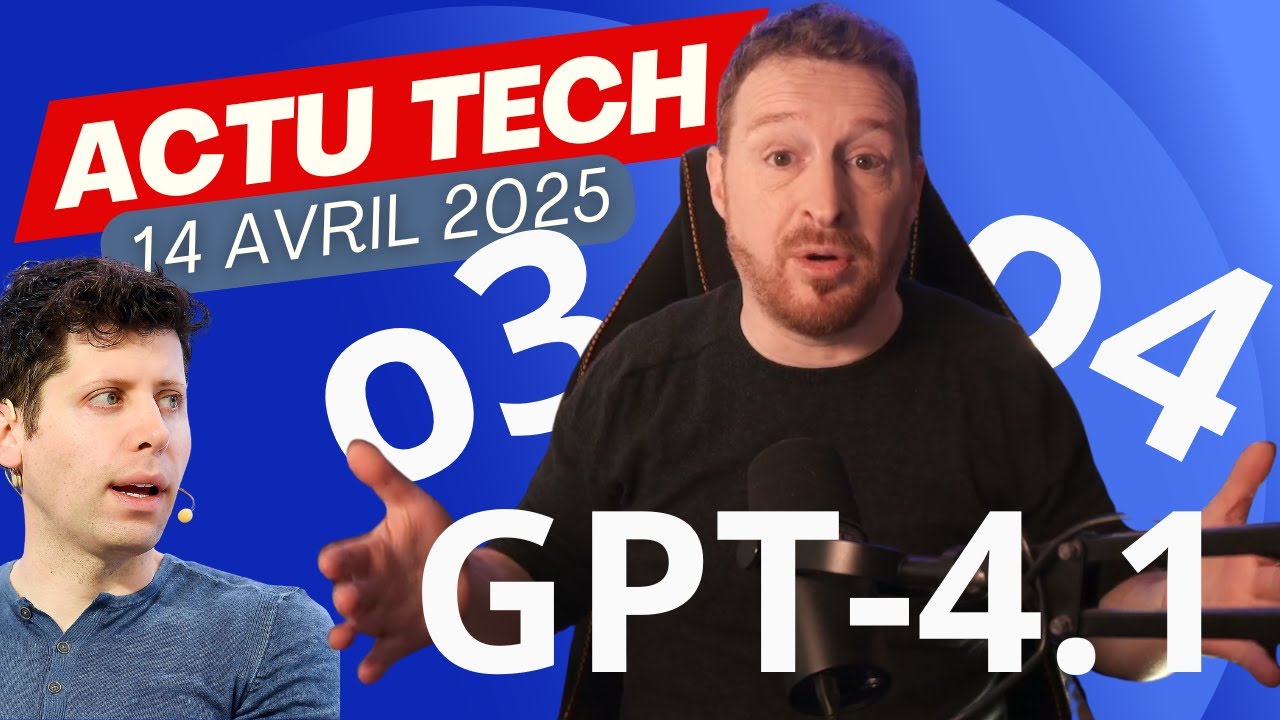
OpenAI lance une nouvelle IA secrète ? GPT-4.1, o3, o4 ?
OpenAI launches a new secret AI? GPT-4.1, o3, o4?
Keywords
Summary
172 words
Critical Evaluation
Value of the Information & Strength of the Argument
The video provides a mix of speculative predictions and factual news summaries. The host clearly labels his OpenAI predictions as speculation, which is honest, but the argumentation often relies on personal opinion and lacks deep analysis. The discussion on GDPR simplification and tariff changes offers some context but stays at a surface level. The segment on Meta’s Llama 4 raises important ethical questions about AI bias, but the argumentation is more provocative than rigorous. Overall, the value lies in aggregating current tech news, but the depth of analysis is limited.
Scientific Rigor, Source Quality, Title Accuracy
The video does not cite specific sources for its claims, relying on general knowledge and rumors. The host mentions ‘rumors’ and ’leaks’ but provides no links or references. The title accurately reflects the speculative focus on OpenAI, but the content covers multiple topics, which is typical for a news roundup. The lack of verifiable sources reduces the scientific rigor, though the host does distinguish between speculation and confirmed news. The video’s structure with chapters helps navigation, but the absence of citations is a notable weakness.
190 words
Title / Content Match
The title accurately reflects the speculative focus on OpenAI's upcoming model releases, though the video covers multiple other tech news topics.
Quality & Reliability
6/10
The video is a speculative news review based on rumors and leaks, with no direct verification of claims. The host clearly labels predictions as speculation, but the content lacks rigorous sourcing and relies heavily on personal interpretation.
Chapters
Cited Sources
- Renaud Dékode's website — Mentioned as a discussion platform for the video's topics.
Concurring Sources
- OpenAI's official announcements — The video's predictions align with typical OpenAI release patterns, but no specific source is cited.
Dissenting Sources
- No direct contradictions found — The video's speculative nature means there are no direct contradictions, but the lack of sources makes verification impossible.
Contribution & Novelties
The video offers a speculative overview of OpenAI’s upcoming models, which may be of interest to enthusiasts, but it does not provide original research or exclusive information. Its main contribution is aggregating recent tech news and raising questions about AI ethics and geopolitics.
Pour aller plus loin :
- OpenAI’s official blog — For official announcements on model releases.
- LMArena leaderboard — To compare AI model performance.
- GDPR official text — To understand the current regulation.
- Sakana AI’s website — For details on ‘The AI Scientist’.
85 words
Radar Profile
The radar profile shows moderate scores across all dimensions, with a slight peak in information quantity and a dip in technical depth. This suggests a balanced but not deeply analytical content, suitable for a general audience.