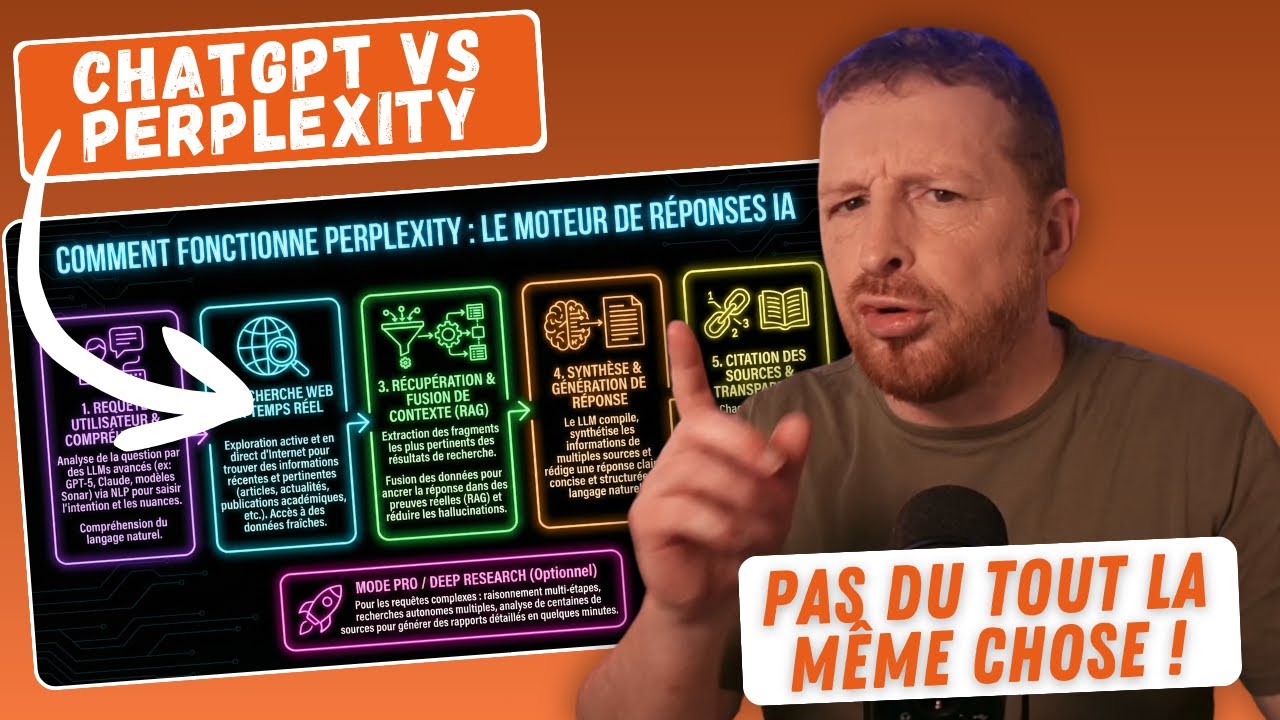
Comprendre ChatGPT vs Perplexity : où faire ses recherches et pourquoi
Understanding ChatGPT vs Perplexity: where to do your research and why
Keywords
Summary
143 words
Critical Evaluation
Value of the Information & Strength of the Argument
The video offers a valuable clarification of the distinct roles of ChatGPT and Perplexity, which is often misunderstood. The argumentation is structured and logical, starting with a basic explanation of LLM training, then contrasting the conversational nature of ChatGPT with the search-oriented architecture of Perplexity. The creator effectively uses analogies (e.g., the drunk guy at the bar) to illustrate the limitations of LLMs. However, the argumentation is based on personal expertise and lacks empirical data or comparative studies. The value lies in its pedagogical approach, making complex concepts accessible to a general audience.
Scientific Rigor, Source Quality, Title Accuracy
The video does not cite any external sources or references, which limits its scientific rigor. The explanation is based on the creator’s understanding and experience, and while it aligns with general knowledge about these tools, it lacks verifiable citations. The title accurately reflects the content, and the video stays on topic throughout. No comments were provided for analysis.
166 words
Title / Content Match
The title accurately reflects the content, which focuses on comparing the two tools and explaining their respective use cases.
Quality & Reliability
6/10
The video provides a clear and accurate high-level explanation of the architectural differences between ChatGPT and Perplexity, but it lacks concrete sources, citations, or references to technical documentation. The explanation is simplified and occasionally uses informal analogies, which may reduce precision for an expert audience.
Key Moments
Markers derived by PSI from the transcript: the creator did not define chapters.
- Introduction: the video aims to explain the fundamental difference between ChatGPT and Perplexity.
- Explanation of how LLMs are trained: data collection, tokenization, and vector representation.
- ChatGPT is presented as a conversational tool, not designed for factual or up-to-date information.
- Perplexity is introduced as a search engine with its own web index, not an AI chatbot.
- Detailed explanation of Perplexity's workflow: query understanding, web index retrieval, and RAG construction.
- Perplexity uses an LLM only to format the final answer based on the RAG, not for the search itself.
- Conclusion: use ChatGPT for conversation and Perplexity for research; avoid common misconceptions.
Cited Sources
- Renaud Dékode's website — The creator's website, mentioned in the video description, where further discussion and resources may be found.
Concurring Sources
- Perplexity AI — The tool itself, which demonstrates the features described in the video.
- OpenAI ChatGPT — The conversational AI tool discussed in the video.
Contribution & Novelties
The video provides a clear and accessible explanation of the architectural differences between ChatGPT and Perplexity, emphasizing the role of RAG in Perplexity’s search process. It corrects common misconceptions about using ChatGPT for research. The novelty lies in its pedagogical approach, making technical concepts understandable for a general audience.
Pour aller plus loin :
- Retrieval-Augmented Generation (RAG) — This concept is central to Perplexity’s functioning, as explained in the video.
- Large language model — Provides background on how LLMs are trained and their limitations.
- Tokenization (lexical analysis) — Explains the tokenization process mentioned in the video.
96 words
Radar Profile
The radar profile shows moderate scores across all dimensions, indicating a balanced but not highly technical or deeply sourced content. The video is informative for a general audience but lacks the depth and citations expected for a scientific analysis.