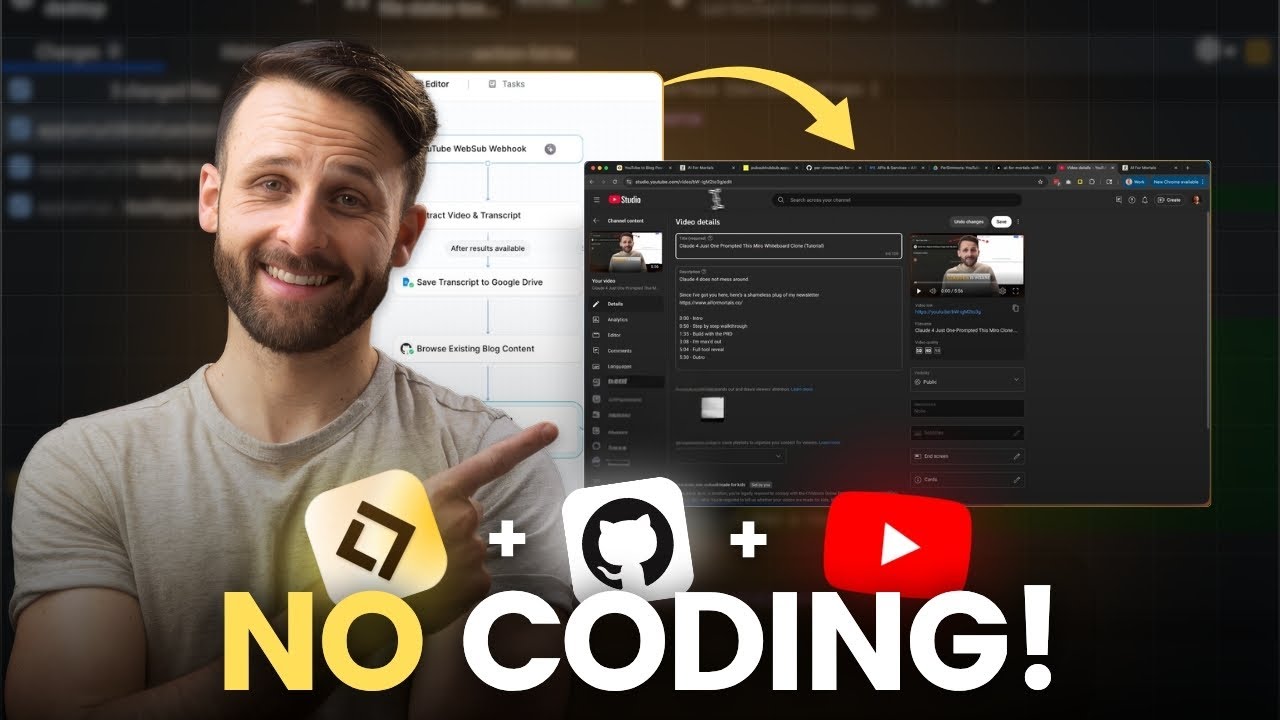
I Built a Complete YouTube Automation in 20 Minutes Using ONLY Natural Language (Lindy 3.0 Tutorial)
Keywords
Summary
149 words
Critical Evaluation
Value of the Information & Strength of the Argument
The video provides a hands-on demonstration of Lindy 3.0’s capabilities, offering practical insights into building automations with natural language. The creator’s argument is that this represents a shift in how automations are built, making them more accessible. The value lies in the step-by-step walkthrough, which includes real troubleshooting (e.g., webhook verification) that viewers can learn from. However, the argumentation is based on a single anecdotal test without comparative analysis or performance metrics, limiting its generalizability. The creator acknowledges limitations, such as the need for manual configuration in some steps, which adds credibility but also tempers the initial enthusiasm.
Scientific Rigor, Source Quality, Title Accuracy
The video is a tutorial with a clear title that matches the content. The creator references specific tools (Lindy, Claude, Vercel, GitHub) and demonstrates their integration. However, no external sources are cited, and the information is based on personal experience. The description includes links to the creator’s bootcamp and newsletter, which are promotional rather than scientific. The video’s rigor is moderate: it shows real steps and issues, but lacks independent verification or references to official documentation. The title accurately reflects the content, and the video’s structure is logical, following the build process chronologically.
206 words
Title / Content Match
The title accurately reflects the content: the creator builds a YouTube automation using natural language within the stated timeframe.
Quality & Reliability
6/10
The video is a practical tutorial demonstrating the use of Lindy 3.0's agent builder to create a YouTube-to-blog automation. The creator shows real steps and encounters genuine issues (webhook verification), but the content is largely anecdotal and lacks independent verification or comparative benchmarks. The tutorial is clear and reproducible, but the scientific rigor is limited by the absence of formal testing or data.
Chapters
Cited Sources
- AI Bootcamp — Mentioned in the video description as a promotional link for the creator's bootcamp.
- AI For Mortals Newsletter — Mentioned in the video description as a newsletter subscription link.
Concurring Sources
- Lindy AI official website — The tool being demonstrated; the video aligns with its advertised capabilities.
Contribution & Novelties
The video showcases the practical application of Lindy 3.0’s agent builder, demonstrating how natural language can be used to create complex automations without manual node configuration. It provides a real-world example of integrating YouTube API, GitHub, and webhooks, offering a template for similar projects. The creator’s approach of stress-testing the tool with a challenging build adds value for viewers interested in AI automation.
Pour aller plus loin :
- WebSub (formerly PubSubHubbub) — Protocol used for real-time notifications, relevant to the webhook setup.
- YouTube Data API v3 — Official documentation for the API used to fetch video details.
- Claude Sonnet 4 — The AI model used for generating blog posts, though the exact version may not be publicly documented.
118 words
Radar Profile
The radar profile shows moderate scores across all dimensions, with slightly higher technical level and information quantity, but lower reliability due to the anecdotal nature and lack of external verification. This suggests a practical tutorial that is informative but not deeply rigorous.