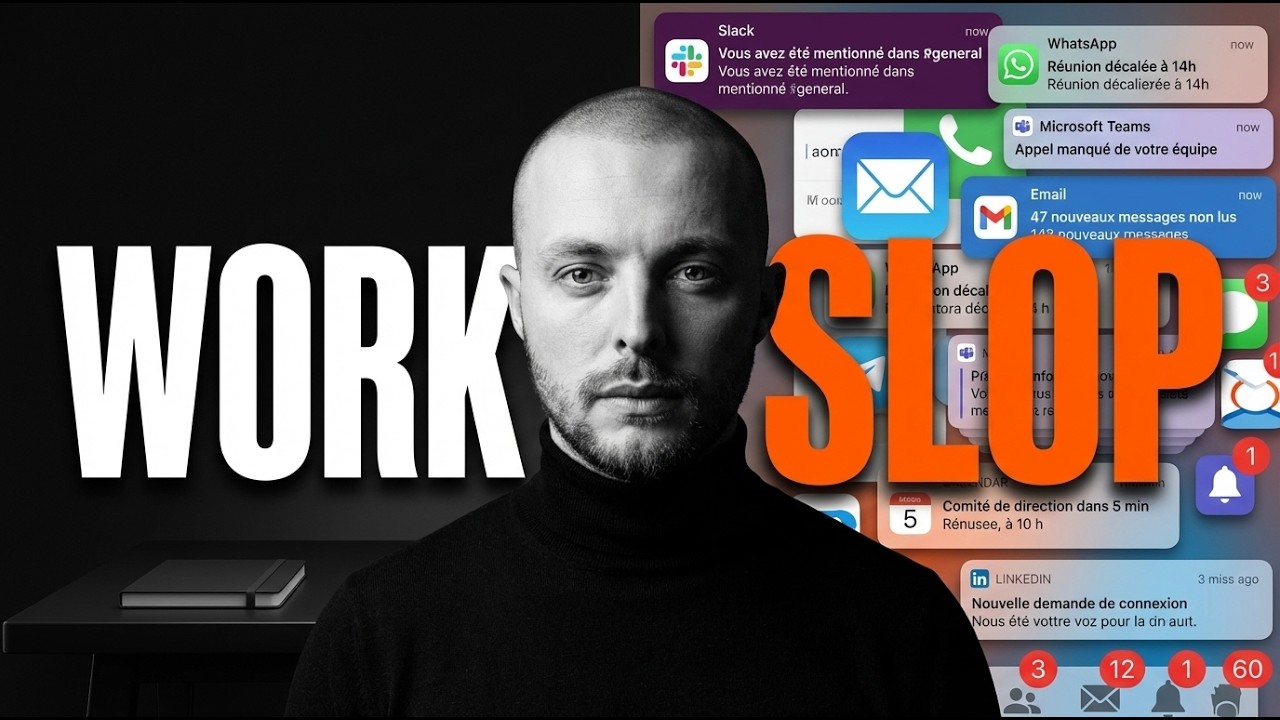
L'IA pense vite. Vous, vous pensez mieux.
AI thinks fast. You think better.
Keywords
Summary
189 words
Critical Evaluation
Value of the Information & Strength of the Argument
The video provides valuable insights into the often-overlooked negative consequences of AI adoption in the workplace, particularly the cognitive and social costs. The argument is well-structured, moving from the definition of ‘workslop’ to its financial impact, then to the deeper issue of cognitive atrophy and trust erosion. The speaker supports his claims with references to several studies, which adds credibility. However, the argumentation is largely one-sided, focusing exclusively on the risks without acknowledging potential benefits or counterarguments. The proposed solutions are practical but somewhat simplistic, and the evidence for their effectiveness is not provided. The speaker’s tone is persuasive, but the lack of nuance may lead to an overly pessimistic view of AI in professional settings.
Scientific Rigor, Source Quality, Title Accuracy
The video references several studies (Stanford, BetterUp, Microsoft Research, Carnegie Mellon, Galileo, Raptive) but does not provide direct citations or links in the description, making it difficult to verify the claims. The title is catchy but somewhat vague, and the content is more about the concept of ‘workslop’ than a direct comparison of AI vs. human thinking. The video is a mix of expert opinion and literature review, but the lack of detailed methodology and the absence of counterarguments reduce its scientific rigor. The description includes a link to the video but no additional sources. The title/content alignment is acceptable, though the title could be more specific.
238 words
Title / Content Match
The title is catchy and aligns with the video's core message that human judgment is superior to AI speed, but it is somewhat vague and does not mention the specific concept of 'workslop'.
Quality & Reliability
6/10
The video presents a coherent argument about the negative effects of AI-generated content in the workplace, supported by references to studies from Stanford, BetterUp, Microsoft Research, Carnegie Mellon, Galileo, and Raptive. However, the claims are presented without detailed methodology or direct citations, and the speaker's own recommendations are largely anecdotal. The overall reliability is moderate.
Chapters
- Le phénomène du Workslop : l'apparence du travail bien fait
- L'impact financier et le volume : 1 document sur 6 concerné
- Le transfert vicieux de la charge cognitive au travail
- Comment l'IA effrite la confiance interpersonnelle
- La culture de la vitesse contre la profondeur du raisonnement
- Les 4 étapes de l'atrophie cognitive face à la machine
- Le danger systémique de la cascade agentique
- Discipline 1 : Le diagnostic intellectuel avant de consulter l'IA
- Discipline 2 : L'entraînement rédactionnel sans assistance
- Discipline 3 : Le filtre de qualité inversé (test de la réunion)
- Conclusion : L'IA comme accélérateur d'exigence ou de détérioration
Cited Sources
- Video description — The description mentions the concept of 'workslop' and provides an overview of the video's content, but does not include direct links to the cited studies.
Concurring Sources
- Stanford University — Mentioned as a source for the term 'workslop' and the study on 1150 professionals.
- BetterUp — Co-author of the study on 'workslop' and its impact on productivity.
- Microsoft Research — Study on the relationship between trust in AI and critical thinking.
- Carnegie Mellon University — Collaborated with Microsoft Research on the study of 319 knowledge workers.
- Galileo — Research on multi-agent systems and error propagation.
- Raptive — Survey on 3000 adults about trust in AI-generated content.
Dissenting Sources
- No direct counter-sources provided — The video does not mention any sources that contradict its claims, but the lack of direct citations makes it difficult to assess potential disagreements.
Contribution & Novelties
The video introduces the concept of ‘workslop’ to a broader audience, synthesizing existing research on AI’s impact on cognitive skills and workplace trust. It offers a practical framework for individuals to maintain their critical thinking in an AI-saturated environment.
Pour aller plus loin :
- Critical thinking — This concept is central to the video’s argument about cognitive atrophy.
- Artificial intelligence in the workplace — Provides context on AI adoption and its effects.
- Cognitive load — Relevant to the discussion of transferring cognitive effort from producers to receivers.
87 words
Radar Profile
The radar profile shows moderate scores across all dimensions, with a slight emphasis on quantity of information and reliability. This suggests a video that provides a good overview of the topic but lacks depth in technical detail and critical evaluation of sources.